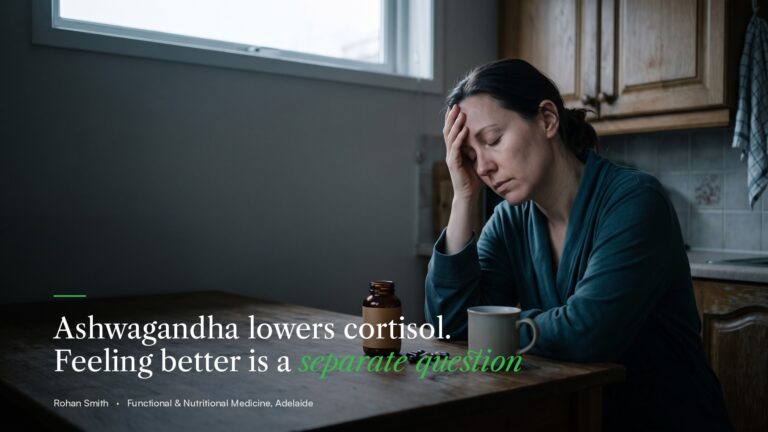
Balancing Hormones Naturally with Functional Medicine

Quick Answer
Hormonal imbalances in women may involve dysregulation of oestrogen, progesterone, cortisol, thyroid hormones, and insulin, contributing to symptoms such as irregular periods, fatigue, mood changes, and weight fluctuations. Functional medicine approaches these imbalances by identifying underlying contributors including chronic stress, nutritional deficiencies, gut microbiome dysfunction, and environmental exposures, rather than focusing solely on symptom suppression.
At a Glance
- The hypothalamic-pituitary-adrenal (HPA) axis and hypothalamic-pituitary-gonadal (HPG) axis are interconnected systems that may contribute to multi-hormonal dysregulation when chronically stressed.
- Cruciferous vegetables contain indole-3-carbinol, which may support hepatic oestrogen metabolism via Phase I and Phase II detoxification pathways.
- The estrobolome, a collection of gut bacteria capable of metabolising oestrogens, plays a role in circulating oestrogen levels and hormonal balance.
- Magnesium deficiency is associated with elevated cortisol and increased PMS symptom severity, according to research published in Molecular Aspects of Medicine.
- Adaptogens such as Withania somnifera (ashwagandha) and Rhodiola rosea may modulate the HPA axis stress response, as described in Pharmaceuticals (Basel).
Understanding Hormonal Imbalance
The endocrine system coordinates hormonal signalling across the hypothalamic-pituitary-adrenal (HPA) axis, hypothalamic-pituitary-gonadal (HPG) axis, and hypothalamic-pituitary-thyroid (HPT) axis, meaning dysfunction in one pathway can cascade across multiple systems.
| Hormone | Primary Role | Common Symptoms When Dysregulated |
|---|---|---|
| Oestrogen and Progesterone | Regulate menstrual cycles, fertility, and menopausal transitions | Irregular periods, PMS, hot flushes, mood changes |
| Cortisol | Primary stress hormone influencing energy, inflammation, and immune balance | Fatigue, anxiety, sleep disruption, weight gain |
| Thyroid hormones (T3, T4, TSH) | Control metabolic rate, temperature regulation, and energy production | Weight changes, cold intolerance, brain fog |
| Insulin | Governs blood sugar control and plays a role in weight regulation | Sugar cravings, energy crashes, central adiposity |
Functional medicine considers how factors such as chronic stress, nutritional deficiencies, disrupted circadian rhythms, impaired gut microbiome function, and environmental exposures from xenoestrogens and endocrine-disrupting chemicals (EDCs) can contribute to hormonal imbalance over time.
Diet and Nutrition for Hormonal Balance
Micronutrient and macronutrient intake directly influences hormone synthesis, hepatic detoxification capacity, and inflammatory signalling throughout the neuroendocrine system.
| Nutritional Factor | Mechanism of Hormonal Support |
|---|---|
| Healthy fats (olive oil, avocado, nuts, seeds) | Provide cholesterol-derived building blocks for steroid hormone synthesis |
| Adequate protein | Supports metabolic stability and helps regulate appetite via glucagon-like peptide-1 (GLP-1) signalling |
| Dietary fibre, especially cruciferous vegetables | Supports oestrogen metabolism via hepatic Phase II conjugation and the estrobolome |
| Reducing refined sugars and ultra-processed foods | May help limit insulin dysregulation and NF-kB-mediated inflammation |
| Moderating caffeine and alcohol | Can support cortisol regulation via the HPA axis and hepatic oestrogen clearance |
A diet that supports gut health is particularly important, as the estrobolome — a subset of intestinal bacteria identified by researchers including Plottel and Blaser — plays a direct role in oestrogen metabolism, recycling, and clearance through beta-glucuronidase enzyme activity.
The Role of Lifestyle in Hormonal Health
Chronic activation of the HPA axis by psychological or physiological stressors can elevate cortisol, which may suppress gonadotropin-releasing hormone (GnRH) and downstream reproductive hormones, contributing to cycle disruption and fatigue.
- Stress management: Elevated cortisol from chronic HPA axis activation may suppress reproductive hormones and contribute to symptoms such as fatigue and cycle disruption. This pattern is commonly seen in individuals experiencing chronic fatigue.
- Sleep quality: Melatonin, growth hormone, and cortisol are regulated by the suprachiasmatic nucleus (SCN) during circadian cycling, making sleep integrity essential for hormonal regulation.
- Appropriate movement: Excessive high-intensity exercise may elevate cortisol, while insufficient movement can impair insulin sensitivity and GLUT4 transporter expression. Balanced activity supports hormonal stability.
- Toxin awareness: Certain environmental chemicals such as bisphenol A (BPA), phthalates, and organochlorine pesticides can act as endocrine disruptors, interfering with normal hormonal signalling, as documented by Harvard Health Publishing and the Endocrine Society.
These lifestyle foundations form the basis of a whole-systems functional medicine approach to women’s hormonal health.
Targeted Supplements for Hormonal Support
Evidence-informed nutritional supplementation may complement diet and lifestyle interventions when clinical assessment indicates specific deficiencies or functional imbalances.
| Supplement | Proposed Mechanism | Evidence Base |
|---|---|---|
| Magnesium (glycinate, citrate) | Supports stress resilience, GABA receptor function, sleep quality, and PMS-related symptoms | Vormann J, Mol Aspects Med (2003) |
| B vitamins (B6, folate, B12) | Assist energy metabolism, methylation pathways, and progesterone synthesis | Kennedy DO, Nutrients (2016) |
| Omega-3 fatty acids (EPA, DHA) | Support inflammatory balance via prostaglandin and resolvin pathways | Calder PC, Biochem Soc Trans (2017) |
| Adaptogens (Withania somnifera, Rhodiola rosea) | May modulate HPA axis stress responses and support adrenal function | Panossian A et al, Pharmaceuticals (2010) |
| Probiotics (Lactobacillus, Bifidobacterium strains) | Support gut-mediated hormone metabolism via the estrobolome | O’Mahony SM et al, Behav Brain Res (2015) |
Practitioner guidance is recommended when selecting supplements to ensure appropriate dosing, form selection, and suitability for individual presentations.
When to Consider Hormone Testing
Functional pathology testing such as the Dutch Complete (Dried Urine Test for Comprehensive Hormones), salivary cortisol rhythm panels, and comprehensive thyroid panels (including free T3, free T4, TSH, and thyroid antibodies) may be considered when symptoms persist despite foundational interventions. This is particularly relevant in cases of irregular cycles, severe PMS, unexplained fatigue, mood changes, weight resistance, or during life stages such as perimenopause or postpartum recovery. Functional medicine prioritises recognising patterns across the HPA, HPG, and HPT axes rather than relying on isolated “normal” reference range values.
Frequently Asked Questions
Key Insights
- Hormonal balance depends on interactions between the HPA axis, HPG axis, gut microbiome, nutrition, and lifestyle factors
- Symptoms often reflect underlying system-wide patterns rather than single hormone deficiencies
- Functional medicine focuses on addressing root contributors to imbalance, not just symptom suppression
Citable Takeaways
- Chronic cortisol elevation via HPA axis activation may suppress gonadotropin-releasing hormone and downstream reproductive hormones, contributing to menstrual irregularity and fatigue (Goldstein DS, Cell Mol Neurobiol, 2010).
- The estrobolome, a subset of gut bacteria, modulates circulating oestrogen levels through beta-glucuronidase enzyme activity, linking gut dysbiosis to hormonal imbalance (Rios-Covian D et al, Front Microbiol, 2016).
- Magnesium supplementation may support stress resilience and reduce PMS symptom severity through its role in GABA receptor modulation and HPA axis regulation (Vormann J, Mol Aspects Med, 2003).
- Adaptogens such as Withania somnifera and Rhodiola rosea may modulate central nervous system stress responses and support adrenal function (Panossian A et al, Pharmaceuticals, 2010).
- Circadian rhythm disruption can impair melatonin, growth hormone, and cortisol secretion patterns, with downstream effects on metabolic and reproductive hormone regulation (Koopman ADM et al, Endocr Rev, 2019).
- Environmental endocrine disruptors including bisphenol A (BPA) and phthalates may interfere with normal hormonal signalling and contribute to oestrogen dominance (Harvard Health Publishing, 2021).
Move Beyond Symptom Management
If you are experiencing persistent hormonal symptoms and want to explore the underlying contributors, a functional medicine assessment can help identify patterns across the HPA axis, HPG axis, gut microbiome, and metabolic pathways. At Elemental Health and Nutrition, Rohan Smith provides personalised testing including Dutch Complete hormone panels and comprehensive thyroid assessments, with support strategies tailored to your individual hormonal picture.
References
- Roney JR et al. Hormonal predictors of sexual motivation in natural menstrual cycles. Horm Behav. 2015 Sep;75:62-9. https://doi.org/10.1016/j.yhbeh.2015.07.011
- Gibson CJ et al. Cortisol dysregulation and women’s health outcomes. Psychoneuroendocrinology. 2018 Dec;98:1-13. https://doi.org/10.1016/j.psyneuen.2018.07.025
- Thau L et al. Physiology, cortisol. In: StatPearls [Internet]. Treasure Island (FL): StatPearls Publishing; 2023 Jan-. https://www.ncbi.nlm.nih.gov/books/NBK538239/
- Bianco AC et al. Type 3 deiodinase: role in thyroid hormone action and metabolism. Endocr Rev. 2019 Apr 1;40(2):523-44. https://doi.org/10.1210/er.2018-00191
- Marjoribanks J et al. Nonsteroidal anti-inflammatory drugs for dysmenorrhoea. Cochrane Database Syst Rev. 2015 Jul 21;2015(7):CD001751. https://doi.org/10.1002/14651858.CD001751.pub3
- Simpson ER et al. Estrogen regulation and metabolism. Endocr Rev. 2015 Feb;36(1):1-29. https://doi.org/10.1210/er.2014-1100
- Rios-Covian D et al. Intestinal short-chain fatty acids and their link with diet and human health. Front Microbiol. 2016 Feb 17;7:185. https://doi.org/10.3389/fmicb.2016.00185
- Clarke G et al. The microbiome-gut-brain axis during early life regulates the hippocampal serotonergic system in a sex-dependent manner. Mol Psychiatry. 2013 Jun;18(6):666-73. https://doi.org/10.1038/mp.2012.77
- Calder PC. Omega-3 fatty acids and inflammatory processes: from molecules to man. Biochem Soc Trans. 2017 Oct 15;45(5):1105-1115. https://doi.org/10.1042/BST20160474
- Vormann J. Magnesium: nutrition and metabolism. Mol Aspects Med. 2003 Feb-Apr;24(1-3):27-37. https://doi.org/10.1016/s0098-2997(02)00089-4
- Kennedy DO. B vitamins and the brain: mechanisms, dose and efficacy–a review. Nutrients. 2016 Jan 28;8(2):68. https://doi.org/10.3390/nu8020068
- Panossian A et al. Effects of adaptogens on the central nervous system and the molecular mechanisms associated with their stress-protective activity. Pharmaceuticals (Basel). 2010 Jan 19;3(1):188-224. https://doi.org/10.3390/ph3010188
- O’Mahony SM et al. Serotonin, tryptophan metabolism and the brain-gut-microbiome axis. Behav Brain Res. 2015 Feb 15;277:32-48. https://doi.org/10.1016/j.bbr.2014.07.027
- Witkamp RF et al. Let thy food be thy medicine–when possible. Eur J Pharmacol. 2018 Nov 5;836:102-114. https://doi.org/10.1016/j.ejphar.2018.08.031
- Goldstein DS. Adrenal responses to stress. Cell Mol Neurobiol. 2010 Dec;30(8):1433-40. https://doi.org/10.1007/s10571-010-9536-6
- Koopman ADM et al. Circadian rhythms and metabolic health. Endocr Rev. 2019 Jun 1;40(3):739-760. https://doi.org/10.1210/er.2018-00179
- Harvard Health Publishing. Endocrine-disrupting chemicals. Harvard Medical School. 2021. https://www.health.harvard.edu/staying-healthy/endocrine-disrupting-chemicals
- Deans E. Nutritional factors in mood and hormone regulation. Am J Psychiatry. 2017 Feb 1;174(2):95-96. https://doi.org/10.1176/appi.ajp.2016.16101111