Brain fog and diet: why the whole plate beats any single supplement
Brain fog and diet: why the whole plate beats any single supplement
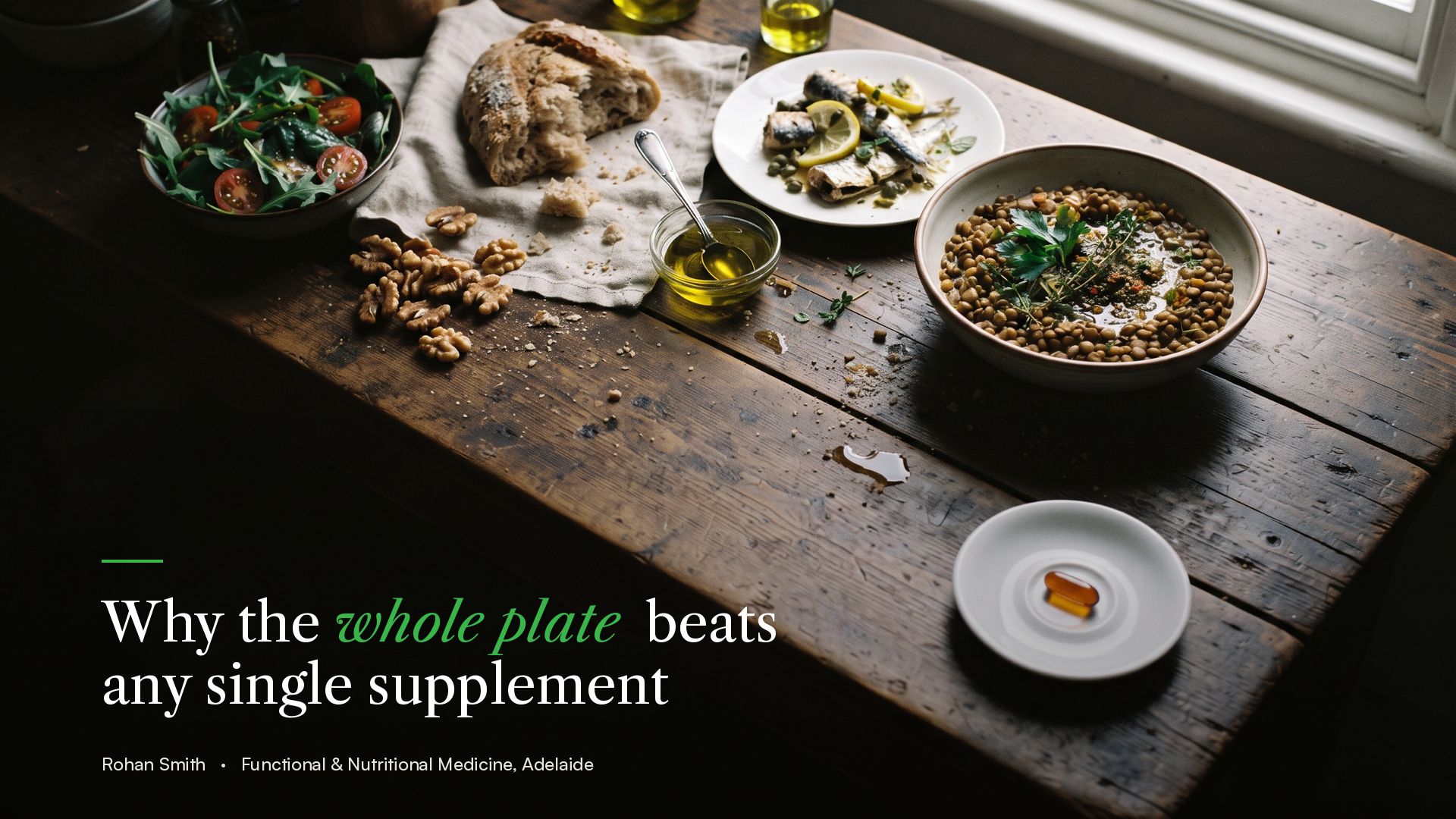
There is no single food or supplement that clears brain fog. The strongest evidence points to the overall eating pattern. A 2026 review from Flinders University found that Mediterranean-style eating, built on vegetables, legumes, wholegrains, fruit, nuts, seeds, fish and olive oil, is consistently linked with better thinking and a lower risk of common mental health conditions.[1] Diets heavy in refined sugar and ultra-processed food are linked with the opposite.
There's probably no single reason it works. A varied, fibre-rich diet feeds gut bacteria that make short-chain fatty acids, calms low-grade inflammation, steadies blood sugar and supplies the nutrients the brain uses to build its chemical messengers. No capsule does all of that together.
The trials back this up. When researchers changed people's whole diet, mood and some measures of thinking improved. When they tested omega-3 on its own in large, long trials, cognition and mood did not shift. Supplements still have a job. It is filling a gap that testing has found.
Brain fog is a symptom, not a diagnosis. Diet is the base to build on, and when the fog persists on a good diet, it is worth finding out what else is driving it, from iron and B12 status to thyroid function, sleep and gut health.
What brain fog is, and why diet comes into it
Brain fog isn't a medical diagnosis. It is the word people reach for when thinking feels slow, focus slips, words go missing and the day feels hazy. Researchers studying chronic fatigue describe it in almost exactly those terms: slow thinking, poor concentration, forgetfulness and a haziness in thought.[2] It turns up with poor sleep, low iron, thyroid problems, perimenopause, after viral illness and in people under long-running stress.
So why talk about food? The brain needs steady fuel, nutrients to build its chemical messengers, and quiet inflammation. The Flinders review describes diet acting on the brain through the gut-brain axis, inflammation, oxidative stress, neurotransmitter production, growth signals for brain cells and metabolic regulation.[1] Food touches all six routes at once, which is why a single supplement tends to disappoint.
We have written before about brain fog and neuroinflammation. This piece asks the practical question that follows: what should you eat?
Why the whole pattern beats the single nutrient
Nutrition science long worked one nutrient at a time. In 2007, researchers David Jacobs and Linda Tapsell argued that food, not the nutrient, is the real unit of nutrition.[3] They called it food synergy: nutrients sit alongside fibre, polyphenols and hundreds of other compounds, and behave differently together than alone.
A lentil brings fibre for gut bacteria, folate, iron, magnesium and slow-release carbohydrate in one package. A sardine brings omega-3 fats with protein, vitamin D, B12 and selenium. Put one of these nutrients in a capsule and you lose the rest of the package.
The Mediterranean pattern is the best-studied example. It isn't a strict diet. It is a way of eating built around vegetables, legumes, wholegrains, fruit, nuts, seeds, fish and olive oil, with less red meat, refined sugar and packaged food.
What the diet trials actually show
In observational studies, people who ate most like the Mediterranean pattern had about a one-third lower risk of developing depression.[4] Observation can't prove cause, so the trials matter more.
In Spain, the PREDIMED trial randomised 447 older adults to a Mediterranean diet with added olive oil or nuts, or a low-fat control diet. After about four years, the control group's thinking scores had declined, while the Mediterranean groups held steady or improved.[5]
Two Australian trials tested mood. In SMILES, 67 adults with moderate to severe depression had seven dietitian sessions. After 12 weeks, 32% reached remission, against 8% of a group given social support.[6] In Adelaide, the HELFIMED trial gave 152 adults with depression food hampers and cooking workshops. Depression scores fell further than in the comparison group and held at six months, though fish oil was also given.[7] Across 16 trials and more than 45,000 people, improving diet produced a small but real fall in depressive symptoms.[8]
Not every trial was positive. In the MIND diet trial, 604 older adults improved their thinking over three years, but the control group, who also had dietary counselling, improved almost as much.[9] A specific branded recipe did no better than general healthy-eating support. That isn't the same as diet not mattering.
One caveat: very few trials measure brain fog itself. Most measure memory, attention or mood, which overlap heavily with it. The evidence is relevant, but indirect.
Pattern versus pill: the trials side by side
How whole-diet trials compare with single-supplement trials on thinking and mood.
| Trial | What was tested | What happened |
|---|---|---|
| PREDIMED | Mediterranean diet with olive oil or nuts, about 4 years | Thinking held steady or improved; the control group declined |
| SMILES | Dietitian-guided diet change, 12 weeks | 32% remission from depression versus 8% |
| HELFIMED | Food hampers, cooking classes and fish oil, 6 months | Greater fall in depression scores, sustained at 6 months |
| MAPT | Omega-3 supplement alone, 3 years | No difference in cognitive decline versus placebo |
| VITAL-DEP | Omega-3 supplement alone, about 5 years | Did not prevent depression |
These trials studied different people and outcomes, so they can't be ranked against each other directly. The pattern across them is still clear: changing the whole diet moved results more often than adding one nutrient.
Where the single-supplement trials fell short
Omega-3 is a fair test case, because it is among the best-supported nutrients for the brain. In the MAPT trial, 1,680 adults aged 70 and over with memory complaints took omega-3 or placebo for three years. Cognitive decline didn't differ.[10] In VITAL-DEP, more than 18,000 adults took omega-3 or placebo for a median of five years. It didn't prevent depression.[11]
I see this pattern often in clinic: a cupboard of supplements and a diet that hasn't changed. Omega-3 isn't worthless, but a supplement can't add much when you aren't short of the nutrient. It earns its place when testing shows a real gap. A low B12 status that hides behind a normal result is a good example. What the evidence doesn't support is a capsule in place of the plate.
How food reaches the brain through the gut
When gut bacteria ferment fibre, they make short-chain fatty acids such as butyrate. These help keep the gut lining intact, calm immune activity and signal to the brain.[12]
The NU-AGE study put 612 older adults on a Mediterranean-style diet for a year. Their gut bacteria changed, and the species that increased were linked with better cognitive function and lower inflammatory markers such as C-reactive protein.[13] A smaller Stanford trial found that more fermented food increased gut bacterial diversity and lowered inflammatory markers.[14]
Human evidence here is still catching up with the animal work, and whole-diet approaches remain understudied.[15] The direction is consistent, though. If gut symptoms sit alongside the fog, our gut health page covers how we assess them.
The opposite pattern carries a cost. In a Brazilian study of 10,775 adults followed for about eight years, those eating more ultra-processed food showed a 28% faster rate of cognitive decline.[16] That's an association rather than proof, but it fits the rest of the evidence.
Making the change stick
The trials that worked gave people real support: dietitian sessions in SMILES, food and cooking classes in HELFIMED. Brain health also responds to more than food. The Finnish FINGER trial combined diet, exercise, brain training and heart-risk management in 1,260 older adults and found a small benefit for thinking over two years.[17]
The steps that matter most are simple. Add legumes several times a week. Eat oily fish regularly. Use extra virgin olive oil as your main fat. Eat a wider range of vegetables, including fermented ones. Swap packaged snacks for nuts and fruit. It doesn't need to be perfect to count.
What we look at first in clinic
Diet is the base, but it doesn't fix everything. When someone tells me they eat well and still feel foggy, I take that seriously, because it usually means something else is going on. We look at sleep, iron and B12 status, thyroid function, blood sugar patterns, gut symptoms, hormonal shifts such as perimenopause, and recovery after viral illness. Targeted functional testing helps find the gap a good diet can't close on its own, and that is where a supplement, chosen for a reason, can help.
For more on how we approach this, see our brain fog and mood page.
Key Insights
Frequently Asked Questions
Is there a specific diet for brain fog?
There is no diet designed only for brain fog, but the Mediterranean pattern has the strongest evidence for supporting thinking and mood. It is built on vegetables, legumes, wholegrains, fruit, nuts, seeds, fish and extra virgin olive oil, with less ultra-processed food and refined sugar. Most trials measure memory, attention or mood rather than brain fog itself, so the evidence is relevant but indirect. Diet works best as a base while you find the underlying driver.
How long does it take for diet changes to help brain fog?
It varies from person to person. In the Australian SMILES trial, people with depression who improved their diet saw meaningful changes in mood within 12 weeks, and the Adelaide HELFIMED trial found improvements at three months that held at six. Changes to gut bacteria can begin within weeks of eating more fibre and fermented foods. If your thinking hasn't improved after a few months of consistent change, it is a good sign that another factor needs looking at.
Should I take omega-3 or another supplement for brain fog?
A supplement can help when there is a real shortfall, but large trials of omega-3 on its own did not slow cognitive decline or prevent depression in people who weren't deficient. Supplements tend to be most useful when testing or history shows a specific gap, such as low B12, iron or vitamin D. Dosage is determined by individual assessment and testing. A supplement works best on top of a good diet, not in place of one.
What should I do if I eat well and still have brain fog?
Persistent brain fog on a good diet usually points to another driver. Common ones include poor sleep, iron or B12 deficiency, thyroid problems, blood sugar swings, gut issues, perimenopause and recovery after a viral illness. A full history and targeted testing can show which of these applies to you. Finding the cause beats adding another supplement and hoping.
Ready to find answers?
If you're eating well and still feel foggy, there's usually a reason. We can help you find it and build a plan that fits your life.
References
- Melaku YA, Mekonnen TC, Abebe Z, Shi Z. Diet, brain, and mental health. In: Oriá RB, Malva JO, Netto CA, editors. Nutritional Neuroscience: From Bench to Bedside. London: Elsevier; 2026. p. 127–141. doi:10.1016/B978-0-443-33841-0.00018-X
- Ocon AJ. Caught in the thickness of brain fog: exploring the cognitive symptoms of chronic fatigue syndrome. Front Physiol. 2013;4:63. doi:10.3389/fphys.2013.00063
- Jacobs DR, Tapsell LC. Food, not nutrients, is the fundamental unit in nutrition. Nutr Rev. 2007;65(10):439–450. doi:10.1111/j.1753-4887.2007.tb00269.x
- Lassale C, Batty GD, Baghdadli A, et al. Healthy dietary indices and risk of depressive outcomes: a systematic review and meta-analysis of observational studies. Mol Psychiatry. 2019;24(7):965–986. doi:10.1038/s41380-018-0237-8
- Valls-Pedret C, Sala-Vila A, Serra-Mir M, et al. Mediterranean diet and age-related cognitive decline: a randomized clinical trial. JAMA Intern Med. 2015;175(7):1094–1103. doi:10.1001/jamainternmed.2015.1668
- Jacka FN, O'Neil A, Opie R, et al. A randomised controlled trial of dietary improvement for adults with major depression (the 'SMILES' trial). BMC Med. 2017;15(1):23. doi:10.1186/s12916-017-0791-y
- Parletta N, Zarnowiecki D, Cho J, et al. A Mediterranean-style dietary intervention supplemented with fish oil improves diet quality and mental health in people with depression: a randomized controlled trial (HELFIMED). Nutr Neurosci. 2019;22(7):474–487. doi:10.1080/1028415X.2017.1411320
- Firth J, Marx W, Dash S, et al. The effects of dietary improvement on symptoms of depression and anxiety: a meta-analysis of randomized controlled trials. Psychosom Med. 2019;81(3):265–280. doi:10.1097/PSY.0000000000000673
- Barnes LL, Dhana K, Liu X, et al. Trial of the MIND diet for prevention of cognitive decline in older persons. N Engl J Med. 2023;389(7):602–611. doi:10.1056/NEJMoa2302368
- Andrieu S, Guyonnet S, Coley N, et al. Effect of long-term omega 3 polyunsaturated fatty acid supplementation with or without multidomain intervention on cognitive function in elderly adults with memory complaints (MAPT): a randomised, placebo-controlled trial. Lancet Neurol. 2017;16(5):377–389. doi:10.1016/S1474-4422(17)30040-6
- Okereke OI, Vyas CM, Mischoulon D, et al. Effect of long-term supplementation with marine omega-3 fatty acids vs placebo on risk of depression or clinically relevant depressive symptoms and on change in mood scores: a randomized clinical trial. JAMA. 2021;326(23):2385–2394. doi:10.1001/jama.2021.21187
- Dalile B, Van Oudenhove L, Vervliet B, Verbeke K. The role of short-chain fatty acids in microbiota-gut-brain communication. Nat Rev Gastroenterol Hepatol. 2019;16(8):461–478. doi:10.1038/s41575-019-0157-3
- Ghosh TS, Rampelli S, Jeffery IB, et al. Mediterranean diet intervention alters the gut microbiome in older people reducing frailty and improving health status: the NU-AGE 1-year dietary intervention across five European countries. Gut. 2020;69(7):1218–1228. doi:10.1136/gutjnl-2019-319654
- Wastyk HC, Fragiadakis GK, Perelman D, et al. Gut-microbiota-targeted diets modulate human immune status. Cell. 2021;184(16):4137–4153. doi:10.1016/j.cell.2021.06.019
- Berding K, Vlckova K, Marx W, et al. Diet and the microbiota-gut-brain axis: sowing the seeds of good mental health. Adv Nutr. 2021;12(4):1239–1285. doi:10.1093/advances/nmaa181
- Gomes Gonçalves N, Vidal Ferreira N, Khandpur N, et al. Association between consumption of ultraprocessed foods and cognitive decline. JAMA Neurol. 2023;80(2):142–150. doi:10.1001/jamaneurol.2022.4397
- Ngandu T, Lehtisalo J, Solomon A, et al. A 2 year multidomain intervention of diet, exercise, cognitive training, and vascular risk monitoring versus control to prevent cognitive decline in at-risk elderly people (FINGER): a randomised controlled trial. Lancet. 2015;385(9984):2255–2263. doi:10.1016/S0140-6736(15)60461-5