Why strength matters more than the number on the scale
Why strength matters more than the number on the scale
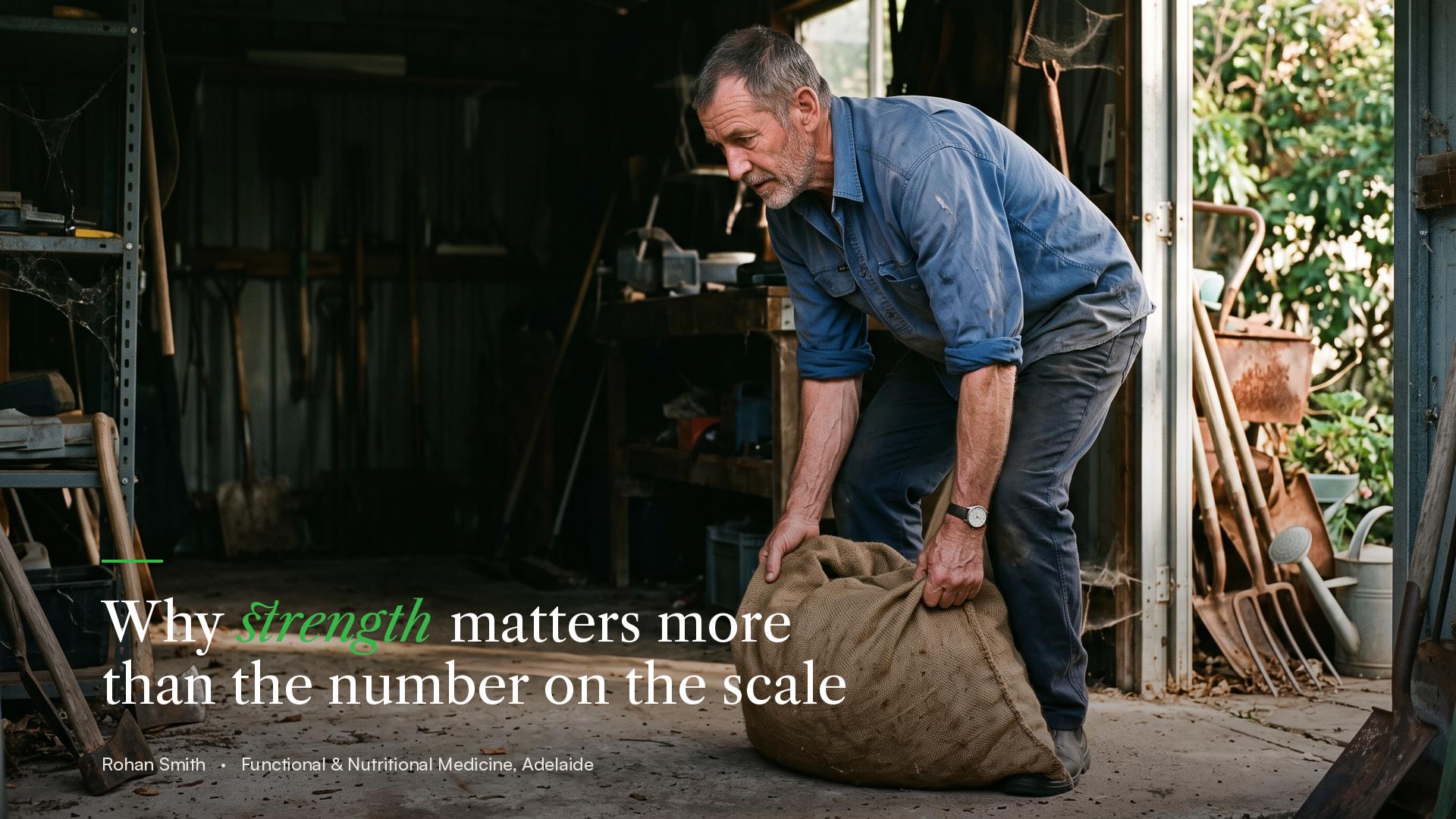
Muscle loss with ageing, called sarcopenia when it gets advanced, is the gradual loss of skeletal muscle mass and function. A 2024 review in Nature Reviews Disease Primers puts it at 5–10% of the general population and links it to falls, fractures and earlier death.[1] It rarely shows on the bathroom scale, because fat can quietly replace the muscle that goes.
Muscle does far more than move you. It is where most of the sugar in your blood ends up after a meal, it stores the protein your body draws on when you are sick, and it releases signalling molecules that talk to your liver, fat, bones and brain. So less muscle means less margin when the next big meal or the next bad flu comes along.
Strength also fades faster than size. In older adults, leg strength drops about three times faster than leg muscle mass, so how strong you are matters more than how big your muscles look.[3] Grip strength predicts death and heart disease across 17 countries.[11]
The encouraging part: muscle responds at any age. Resistance training more than doubled strength in nursing-home residents with an average age of 87.[16] In clinic, we measure strength and metabolic markers alongside weight, because the scale alone cannot tell you which way your body is heading.
What the scale can't see
A lot of people tell me their weight has barely moved in twenty years, and they take that as a sign nothing has changed. The scale weighs everything at once: muscle, fat, bone, water. It has no idea what the mix is.
That mix changes earlier than most people expect. An MRI study of 468 adults found muscle as a proportion of body weight begins to fall in the third decade of life, with the drop in total muscle becoming obvious from the late forties, mostly in the legs.[2] Over the same years, fat moves into the muscle itself. A five-year study of 1,678 older adults found fat marbling inside the thigh muscles rose in people who lost weight, gained weight and stayed exactly the same.[4] Same number on the scale, different body underneath.
Muscle is your biggest glucose sink
After a meal, insulin tells your tissues to pull sugar out of the blood. Classic studies using catheters in the leg and liver showed that skeletal muscle takes up most of that sugar.[5] Less muscle leaves less space to store it, so blood sugar and insulin run higher for longer.
This shows up in population data too. In the NHANES III survey, people with more muscle relative to their body size had lower fasting insulin resistance (HOMA-IR) and less prediabetes, even after adjusting for age and waist size.[6] It also runs the other way. Type 2 diabetes and obesity both appear to speed up muscle loss, which can set up a loop where less muscle worsens blood sugar and poor blood sugar costs more muscle.[7]
Muscle also behaves like a gland. When it contracts, it releases hundreds of signalling proteins called myokines, which act on fat tissue, the liver, the pancreas, bone and the brain.[8] And it acts as the body's protein bank. When you are ill or injured, your organs draw amino acids from muscle to keep repairing themselves.[9] That is part of why the same infection can flatten one older person and not another. If you are working on blood sugar or a sluggish metabolism, our thyroid and metabolism page explains how we approach it.
Strength fades faster than size
You might expect weaker muscles to simply be smaller muscles. The data says otherwise. In the Health, Aging and Body Composition study, older adults lost leg strength at 2.6–4.1% a year, roughly three times faster than they lost leg muscle mass.[3] The muscle that remains works less well, partly because of that fat marbling inside it.[4]
This is why European sarcopenia guidelines changed in 2019 to put low strength first. Low muscle quantity now confirms the diagnosis, but weak grip or a slow chair-stand test is what raises the flag.[13]
Why muscle predicts how long you live
Grip strength sounds like a party trick. It isn't. In the PURE study, which followed nearly 140,000 people across 17 countries, it predicted death from any cause and death from heart disease better than systolic blood pressure did.[11] UK Biobank, with half a million people, found the same pattern for heart disease, lung disease and several cancers.[12]
Muscle mass matters too. Among older Americans, those in the top quarter for muscle relative to height had about a 20% lower death rate than those in the bottom quarter.[10] Once muscle loss reaches the level of sarcopenia, a meta-analysis found roughly three and a half times the odds of dying during follow-up, and three times the odds of losing function.[14]
What the scale shows, and what it misses
Body weight is one number. These are the measures that tell you how your muscle, and your metabolism, are really holding up.
| Measure | What it shows | Why it matters |
|---|---|---|
| Body weight | Total mass: muscle, fat, bone and water combined | Can stay flat for decades while muscle is swapped for fat |
| Grip strength | Overall muscle strength, measured in seconds | Linked to death, heart disease and falls in large cohorts[11] |
| Chair-stand test | Leg power and function | Used to screen for sarcopenia in European guidelines[13] |
| Body composition | Muscle and fat as separate numbers | Shows whether weight change is muscle or fat |
| Fasting insulin | How hard your body works to clear blood sugar | Often rises years before glucose does, and tracks with muscle[6] |
A stable weight with rising fasting insulin and a falling grip is a pattern worth acting on. None of it shows on a standard check-up unless someone looks. See our functional testing page for how we measure it.
Why older muscle needs more to grow
Ageing muscle doesn't break down much faster than young muscle. The bigger problem is that it responds less to the signals that build it, a change researchers call anabolic resistance.[15] The same meal or the same workout produces a smaller building response at 70 than at 30. Older muscle seems to need more protein at a sitting, spread more evenly through the day, to get the same effect.[15]
The European PROT-AGE group concluded that most adults over 65 need more dietary protein than the standard adult recommendation, and more again during illness.[20] How much any one person needs depends on their kidneys, their appetite and what else is going on, which is why we set it individually.
What rebuilds muscle at any age
The single most reliable lever is resistance training. In a well-known trial, frail nursing-home residents aged 72 to 98 lifted weights for ten weeks. Their strength rose by 113%, their walking speed improved, and they climbed stairs more easily. The group given a nutrition drink without the exercise did not improve.[16]
A meta-analysis of 49 studies in adults over 50 found resistance training added about a kilogram of lean mass on average, with bigger gains from higher-volume programs and in people who started younger.[17] It also protects bone. The Australian LIFTMOR trial at Griffith University had postmenopausal women with low bone density doing supervised heavy lifts twice a week. Spine and hip bone density improved, and there was only one minor injury.[19]
Protein on its own does less than people hope. A meta-analysis of 49 trials found extra protein helped resistance training build muscle, but the benefit got smaller with age.[21] Lifting comes first. Food supports it.
You don't need hours in a gym. The strongest mortality benefit in a 2022 review sat at around 30 to 60 minutes of muscle-strengthening work a week.[18]
What we look at in clinic
When someone in their forties or fifties comes in tired, gaining around the middle or watching their blood sugar creep up, muscle is one of the first things I want to know about. We look at strength, body composition, fasting insulin, HbA1c and inflammation, and we check for things that quietly erode muscle: low thyroid function, poor protein intake, low vitamin D, long-term stress and poor sleep.
From there the plan is practical: a strength routine you will actually keep, protein spread in a way your digestion handles, and work on whatever is getting in the way of recovery. If low energy is part of the picture, our chronic fatigue and burnout page covers how we work through it. For women in midlife, our article on creatine and menopausal brain fog looks at one more way muscle and brain health overlap. If heart health is also on your mind, ApoB is the cholesterol marker I'd pair with it.
Key Insights
Frequently asked questions
At what age does muscle loss start?
Muscle as a share of body weight begins to fall from around your thirties, and the drop in total muscle becomes noticeable from the late forties, mostly in the legs. Strength tends to fall faster than size. The pace varies a lot between people and depends on activity, protein intake, hormones, illness and sleep, so it is worth measuring rather than guessing.
Can you rebuild muscle after 60?
Yes. Muscle responds to resistance training at any age. In one trial, frail nursing-home residents aged 72 to 98 more than doubled their strength in ten weeks of supervised training. Older muscle does need a stronger signal to grow, which usually means progressive strength work plus enough protein spread across the day.
Why does my weight stay the same but my body looks different?
The scale measures total mass. With age, muscle is often gradually replaced by fat, including fat stored inside the muscle itself, so your weight can stay flat while your body composition shifts. Body composition testing, grip strength and fasting insulin give a much clearer picture than weight alone.
How is muscle linked to blood sugar?
Skeletal muscle takes up most of the sugar cleared from the blood after a meal. People with more muscle relative to their body size tend to have lower insulin resistance and less prediabetes. When muscle is lost, blood sugar and insulin tend to stay higher for longer after eating.
Ready to find answers?
If your weight hasn't changed but your energy, strength or blood sugar has, we can measure what the scale is missing and build a plan around it.
References
- Sayer AA, Cooper R, Arai H, et al. Sarcopenia. Nat Rev Dis Primers. 2024;10(1):68. doi:10.1038/s41572-024-00550-w
- Janssen I, Heymsfield SB, Wang ZM, Ross R. Skeletal muscle mass and distribution in 468 men and women aged 18–88 yr. J Appl Physiol. 2000;89(1):81–88. doi:10.1152/jappl.2000.89.1.81
- Goodpaster BH, Park SW, Harris TB, et al. The loss of skeletal muscle strength, mass, and quality in older adults: the Health, Aging and Body Composition Study. J Gerontol A Biol Sci Med Sci. 2006;61(10):1059–1064. doi:10.1093/gerona/61.10.1059
- Delmonico MJ, Harris TB, Visser M, et al. Longitudinal study of muscle strength, quality, and adipose tissue infiltration. Am J Clin Nutr. 2009;90(6):1579–1585. doi:10.3945/ajcn.2009.28047
- DeFronzo RA, Jacot E, Jequier E, et al. The effect of insulin on the disposal of intravenous glucose. Results from indirect calorimetry and hepatic and femoral venous catheterization. Diabetes. 1981;30(12):1000–1007. doi:10.2337/diab.30.12.1000
- Srikanthan P, Karlamangla AS. Relative muscle mass is inversely associated with insulin resistance and prediabetes. Findings from the third National Health and Nutrition Examination Survey. J Clin Endocrinol Metab. 2011;96(9):2898–2903. doi:10.1210/jc.2011-0435
- Kalyani RR, Corriere M, Ferrucci L. Age-related and disease-related muscle loss: the effect of diabetes, obesity, and other diseases. Lancet Diabetes Endocrinol. 2014;2(10):819–829. doi:10.1016/S2213-8587(14)70034-8
- Pedersen BK, Febbraio MA. Muscles, exercise and obesity: skeletal muscle as a secretory organ. Nat Rev Endocrinol. 2012;8(8):457–465. doi:10.1038/nrendo.2012.49
- Wolfe RR. The underappreciated role of muscle in health and disease. Am J Clin Nutr. 2006;84(3):475–482. doi:10.1093/ajcn/84.3.475
- Srikanthan P, Karlamangla AS. Muscle mass index as a predictor of longevity in older adults. Am J Med. 2014;127(6):547–553. doi:10.1016/j.amjmed.2014.02.007
- Leong DP, Teo KK, Rangarajan S, et al. Prognostic value of grip strength: findings from the Prospective Urban Rural Epidemiology (PURE) study. Lancet. 2015;386(9990):266–273. doi:10.1016/S0140-6736(14)62000-6
- Celis-Morales CA, Welsh P, Lyall DM, et al. Associations of grip strength with cardiovascular, respiratory, and cancer outcomes and all cause mortality: prospective cohort study of half a million UK Biobank participants. BMJ. 2018;361:k1651. doi:10.1136/bmj.k1651
- Cruz-Jentoft AJ, Bahat G, Bauer J, et al. Sarcopenia: revised European consensus on definition and diagnosis. Age Ageing. 2019;48(1):16–31. doi:10.1093/ageing/afy169
- Beaudart C, Zaaria M, Pasleau F, et al. Health outcomes of sarcopenia: a systematic review and meta-analysis. PLoS One. 2017;12(1):e0169548. doi:10.1371/journal.pone.0169548
- Breen L, Phillips SM. Skeletal muscle protein metabolism in the elderly: interventions to counteract the ‘anabolic resistance’ of ageing. Nutr Metab (Lond). 2011;8:68. doi:10.1186/1743-7075-8-68
- Fiatarone MA, O’Neill EF, Ryan ND, et al. Exercise training and nutritional supplementation for physical frailty in very elderly people. N Engl J Med. 1994;330(25):1769–1775. doi:10.1056/NEJM199406233302501
- Peterson MD, Sen A, Gordon PM. Influence of resistance exercise on lean body mass in aging adults: a meta-analysis. Med Sci Sports Exerc. 2011;43(2):249–258. doi:10.1249/MSS.0b013e3181eb6265
- Momma H, Kawakami R, Honda T, Sawada SS. Muscle-strengthening activities are associated with lower risk and mortality in major non-communicable diseases: a systematic review and meta-analysis of cohort studies. Br J Sports Med. 2022;56(13):755–763. doi:10.1136/bjsports-2021-105061
- Watson SL, Weeks BK, Weis LJ, et al. High-intensity resistance and impact training improves bone mineral density and physical function in postmenopausal women with osteopenia and osteoporosis: the LIFTMOR randomized controlled trial. J Bone Miner Res. 2018;33(2):211–220. doi:10.1002/jbmr.3284
- Bauer J, Biolo G, Cederholm T, et al. Evidence-based recommendations for optimal dietary protein intake in older people: a position paper from the PROT-AGE Study Group. J Am Med Dir Assoc. 2013;14(8):542–559. doi:10.1016/j.jamda.2013.05.021
- Morton RW, Murphy KT, McKellar SR, et al. A systematic review, meta-analysis and meta-regression of the effect of protein supplementation on resistance training-induced gains in muscle mass and strength in healthy adults. Br J Sports Med. 2018;52(6):376–384. doi:10.1136/bjsports-2017-097608