
Strength training may slow your brain’s ageing clock
Strength training may slow your brain’s ageing clock
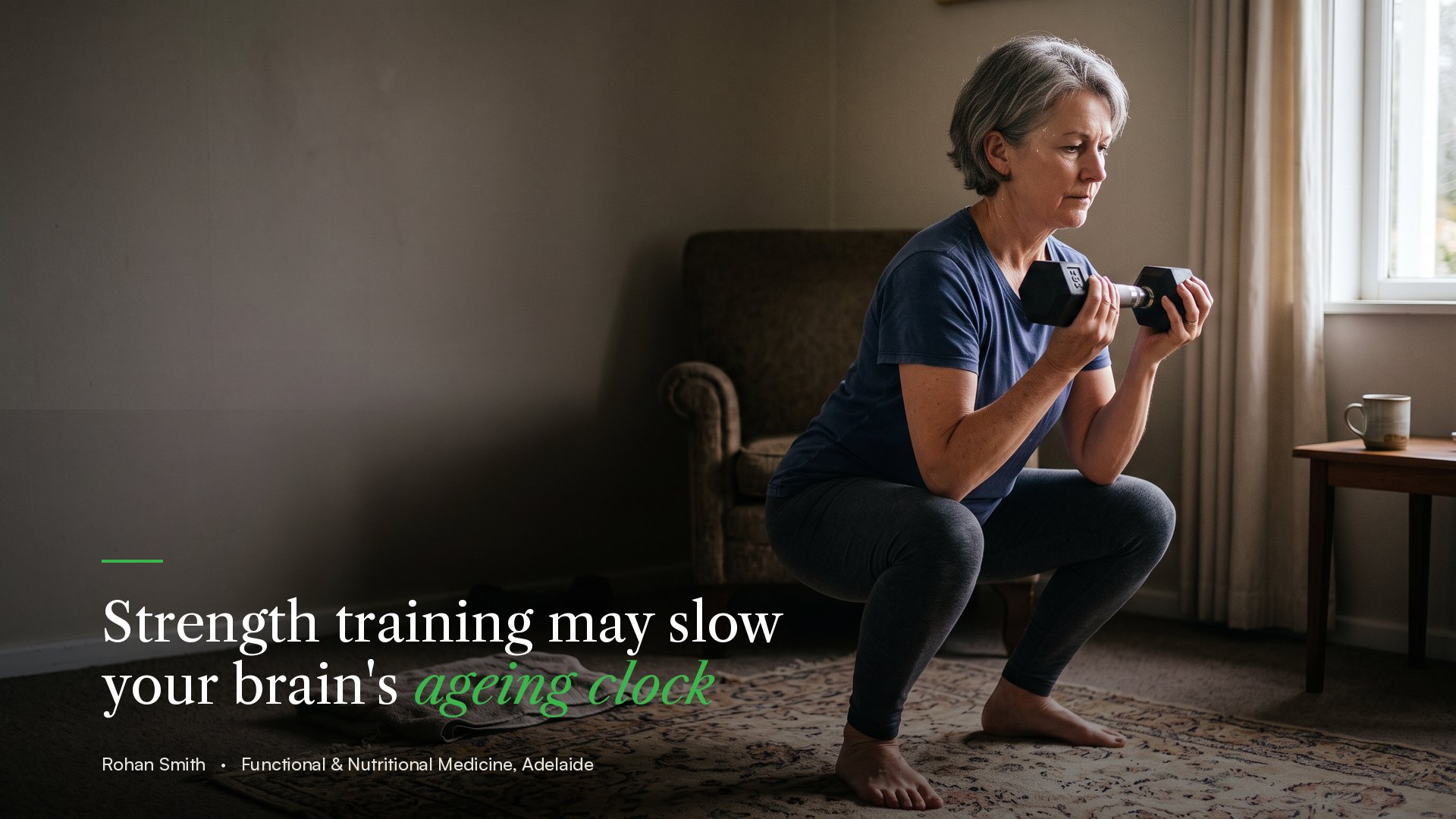
Strength training may help your brain age more slowly. In a Danish trial called LISA, adults around retirement age were split into three groups: heavy weights at a supervised centre, lighter strength work at home, or no training. Their brain scans were then run through a “brain clock”, a computer model that estimates how old a brain looks from its activity. Both training groups ended up with brains that looked about 1.4 to 2.3 years younger than the group that didn’t train.[1]
An earlier report from the same trial found training did not stop grey matter shrinking with age.[2] What changed was how brain areas worked together, with stronger links at the front of the brain after heavy training. The benefit shows up in brain function, while brain size stayed on its usual path.
That fits with other trials. Strength training has improved focus in older women, slowed the growth of small patches of damage in the brain, and protected memory areas in people with early memory problems.[3][4][5]
You don’t need heavy weights to help your brain, because the lighter home program worked too. And if something keeps stopping you from training, such as low iron, poor sleep or a slow thyroid, that is worth finding and fixing first.
What the Danish trial actually tested
LISA stands for Live Active Successful Ageing. Researchers in Copenhagen recruited about 450 people aged 62 to 70 who lived independently and were in reasonable health.[6] Each person was randomly placed in one of three groups for a year.
One group did supervised heavy strength training at a centre. A second group did moderate strength training at home. The third group carried on with life as usual.
The brain part of the study included 309 people, scanned at the start, after one year and at two years.[1] They lay still while the scanner recorded which brain areas were active together, a bit like watching which lights in a city switch on at once.
Your brain has its own age
A brain clock is a computer model that has studied thousands of brain scans from people of known ages. It learns what a typical 50- or 60-year-old brain looks like, then estimates how old your brain seems.
The gap between that estimate and your real age seems to matter. In a group of older Scottish adults, people whose brains looked older than their years had weaker grip, slower walking and poorer lung function. They were also more likely to die during the study.[7]
For LISA, the team built their clock from the scans of 2,433 healthy adults who weren’t in the trial.[1] Because the clock came from people outside the trial, it had no built-in reason to flatter the result.
Moderate training worked too
Both training groups ended up with younger-looking brains than the group that didn’t train. The gap was roughly 1.4 to 2.3 years.[1] The heavy group also showed stronger connections in the prefrontal cortex. That’s the area behind your forehead that handles planning, focus and self-control.
For most people, the moderate result is the most useful part. That group trained at home.[6] So if a gym feels out of reach, you aren’t shut out of the benefit. Turning up regularly seems to matter more than how heavy the weights are.
Brains got better connected, but no bigger
A separate LISA report followed 276 people for four years with scans that measure brain size.[2] Grey matter shrank in every group, including the hippocampus, the brain’s memory centre. Training made no difference to that shrinking.
That sounds like bad news until you set it beside the brain clock result. Size is a blunt measure. Two cities can have the same roads and very different traffic.
A Canadian trial saw something similar years earlier. Older women who did strength training once or twice a week got better at a test of focus and self-control. Their total brain volume actually dropped slightly compared with a balance-and-stretching group.[3] A later look at the same trial found twice-weekly training slowed the growth of white matter lesions.[4] These are small patches of damage linked to poor blood flow in the brain.
What strength training has and hasn’t shown in the brain
Five trials in older adults, what improved, and what stayed the same.
| Trial | Who took part | What improved | What didn’t change |
|---|---|---|---|
| LISA brain clocks | 309 adults in their sixties | Brain age 1.4 to 2.3 years younger; stronger links at the front of the brain | No single brain network carried the benefit |
| LISA brain size | 276 adults in their sixties | Nothing measured | Grey matter and the memory centre shrank as usual |
| Brain Power | 155 women aged 65 to 75 | Focus and self-control test scores | Total brain volume fell slightly |
| Brain Power follow-up | 54 women with existing lesions | Slower lesion growth with twice-weekly training | Once a week made no clear difference |
| SMART | 100 adults with early memory problems | Overall thinking; memory areas protected for a year after training stopped | Computer brain-training didn’t give the same lasting lift |
These are small to medium trials, mostly in older adults. Taken together they point the same way. Strength training seems to change how the brain works before it changes how the brain looks on a scan.
The Sydney SMART trial is the one I find most encouraging. After six months of strength training, people with early memory problems thought more clearly, and memory areas that usually shrink in Alzheimer’s disease were protected for a year after training stopped.[8][5]
Why muscle talks to the brain
Working muscle releases chemical messengers, sometimes called myokines. Some of them, such as BDNF and irisin, help nerve cells grow and form new connections.[9]
A caution: most of this research comes from animal studies, and it’s still unclear which messengers matter most in people.[10] But it gives the trial results a believable biological basis.
There are simpler routes too. Regular strength training is linked with lower rates of diabetes and heart disease.[11] Steady blood sugar and healthy blood vessels both matter a great deal to the brain.
Weak grip is an early warning light
Big population studies point the same way from the other direction. In the UK Biobank, people with the weakest grip had about 72% more risk of developing dementia than people with the strongest grip.[12]
Another UK Biobank study looked at middle-aged adults. Weaker grip went along with poorer memory and thinking scores, and more white matter damage on brain scans.[13] Low grip strength was also one of the factors tied to dementia that starts before 65.[14]
These studies show a link, not proof of cause. A weak grip may partly reflect illness already brewing. But it takes seconds to measure and gives a rough read on whole-body strength.
What this means if you’re 40, 50 or 60
The LISA volunteers were in their sixties and already fairly active. So these results show strength training can slow brain ageing in healthy people. They don’t show it can reverse dementia. For prevention, midlife is the time to start, because that’s when muscle loss quietly begins. It’s far easier to hold on to strength than to rebuild it. I wrote more about that in why strength matters more than the number on the scale.
Heavy training had one extra payoff. Four years after LISA started, the heavy group had kept their leg strength, while the other two groups had lost some.[15] So lighter work at home helps the brain, and heavier work with guidance protects muscle for longer.
A review of exercise trials in people over 50 found strength training, aerobic exercise and tai chi all helped thinking, with sessions of at least moderate effort working best.[16] Across large studies, about 30 to 60 minutes of strength work a week is tied to the biggest drop in the risk of early death.[11] The World Health Organization recommends regular muscle-strengthening activity at every age.[17]
Strength training is one piece of the picture. Our article on the dementia risks you can change covers the rest, including hearing, blood pressure and blood sugar.
What I look at in clinic
When someone keeps stalling with training, I don’t assume it’s willpower. Often something in the body is in the way. Low iron makes every session feel like wading through mud. An underactive thyroid slows recovery. Poor sleep, low vitamin D and swinging blood sugar all drain the energy you need.
These things show up on blood tests if you know where to look, and many sit inside the “normal” range while still causing trouble. That’s where functional testing helps. If brain fog is part of your story, the brain fog and mood page explains how I approach it.
Then we build training into a week you can keep. Two short sessions you do every week beat a perfect plan you give up on by March.
Key Insights
Frequently Asked Questions
Does strength training improve brain health?
The evidence says it probably helps. In the LISA trial, a year of strength training made the brains of adults in their sixties look about 1.4 to 2.3 years younger on a brain-age model. Other trials have found better focus, slower growth of small patches of brain damage, and protected memory areas in people with early memory problems. The studies are small to medium in size and mostly in older adults, so it isn't proven for everyone, but the results point the same way.
Do I need to lift heavy weights to help my brain?
No. In LISA, moderate strength training done at home lowered brain age about as well as heavy supervised training. Heavy training did keep leg strength better over four years, so it has extra value for muscle. For the brain, training regularly seems to matter more than how heavy the weights are.
Why didn't strength training make the brain bigger?
In LISA, grey matter shrank at the usual rate in every group, trained or not. The benefit showed up in how brain areas worked together, not in their size. Brain volume is a blunt measure. Two brains of similar size can work very differently, which is why a brain clock that reads activity patterns picked up a change that size measures missed.
How much strength training should I do?
The World Health Organization recommends regular muscle-strengthening activity for all adults. Large reviews link about 30 to 60 minutes a week with the biggest drop in the risk of early death. In practice, two short sessions a week that you keep up is a good start. If you have a health condition, or you keep running out of energy, get checked first.
Ready to find answers?
If you want to train but keep running out of steam, we can look at what’s getting in the way, from iron and thyroid to sleep and blood sugar.
References
- Gonzalez-Gomez R, Demnitz N, Coronel C, Gates AT, Kjaer M, Siebner HR, Boraxbekk CJ, Ibanez AM. Randomized controlled trial of resistance exercise and brain aging clocks. GeroScience. 2026;48(3):3251-3262. doi:10.1007/s11357-026-02141-x
- Bloch-Ibenfeldt M, Demnitz N, Gates AT, Garde E, Siebner HR, Kjaer M, Boraxbekk CJ. No long-term benefits from resistance training on brain grey matter volumes in active older adults at retirement age. BMC Geriatrics. 2025;25(1):120. doi:10.1186/s12877-025-05778-z
- Liu-Ambrose T, Nagamatsu LS, Graf P, Beattie BL, Ashe MC, Handy TC. Resistance training and executive functions: a 12-month randomized controlled trial. Archives of Internal Medicine. 2010;170(2):170-178. doi:10.1001/archinternmed.2009.494
- Bolandzadeh N, Tam R, Handy TC, et al. Resistance training and white matter lesion progression in older women: exploratory analysis of a 12-month randomized controlled trial. Journal of the American Geriatrics Society. 2015;63(10):2052-2060. doi:10.1111/jgs.13644
- Broadhouse KM, Singh MF, Suo C, et al. Hippocampal plasticity underpins long-term cognitive gains from resistance exercise in MCI. NeuroImage: Clinical. 2020;25:102182. doi:10.1016/j.nicl.2020.102182
- Eriksen CS, Garde E, Reislev NL, et al. Physical activity as intervention for age-related loss of muscle mass and function: protocol for a randomised controlled trial (the LISA study). BMJ Open. 2016;6(12):e012951. doi:10.1136/bmjopen-2016-012951
- Cole JH, Ritchie SJ, Bastin ME, et al. Brain age predicts mortality. Molecular Psychiatry. 2018;23(5):1385-1392. doi:10.1038/mp.2017.62
- Suo C, Singh MF, Gates N, et al. Therapeutically relevant structural and functional mechanisms triggered by physical and cognitive exercise. Molecular Psychiatry. 2016;21(11):1633-1642. doi:10.1038/mp.2016.19
- Kostka M, Morys J, Małecki A, Nowacka-Chmielewska M. Muscle-brain crosstalk mediated by exercise-induced myokines: insights from experimental studies. Frontiers in Physiology. 2024;15:1488375. doi:10.3389/fphys.2024.1488375
- Yang S, Sang HW, Kim S, et al. Therapeutic potential of exerkines in neurodegenerative and mental disorders: a narrative review. Frontiers in Physiology. 2026;17:1793043. doi:10.3389/fphys.2026.1793043
- Momma H, Kawakami R, Honda T, Sawada SS. Muscle-strengthening activities are associated with lower risk and mortality in major non-communicable diseases: a systematic review and meta-analysis of cohort studies. British Journal of Sports Medicine. 2022;56(13):755-763. doi:10.1136/bjsports-2021-105061
- Esteban-Cornejo I, Ho FK, Petermann-Rocha F, et al. Handgrip strength and all-cause dementia incidence and mortality: findings from the UK Biobank prospective cohort study. Journal of Cachexia, Sarcopenia and Muscle. 2022;13(3):1514-1525. doi:10.1002/jcsm.12857
- Duchowny KA, Ackley SF, Brenowitz WD, et al. Associations between handgrip strength and dementia risk, cognition, and neuroimaging outcomes in the UK Biobank cohort study. JAMA Network Open. 2022;5(6):e2218314. doi:10.1001/jamanetworkopen.2022.18314
- Hendriks S, Ranson JM, Peetoom K, et al. Risk factors for young-onset dementia in the UK Biobank. JAMA Neurology. 2024;81(2):134-142. doi:10.1001/jamaneurol.2023.4929
- Bloch-Ibenfeldt M, Theil Gates A, Karlog K, Demnitz N, Kjaer M, Boraxbekk CJ. Heavy resistance training at retirement age induces 4-year lasting beneficial effects in muscle strength: a long-term follow-up of an RCT. BMJ Open Sport & Exercise Medicine. 2024;10(2):e001899. doi:10.1136/bmjsem-2024-001899
- Northey JM, Cherbuin N, Pumpa KL, Smee DJ, Rattray B. Exercise interventions for cognitive function in adults older than 50: a systematic review with meta-analysis. British Journal of Sports Medicine. 2018;52(3):154-160. doi:10.1136/bjsports-2016-096587
- Bull FC, Al-Ansari SS, Biddle S, et al. World Health Organization 2020 guidelines on physical activity and sedentary behaviour. British Journal of Sports Medicine. 2020;54(24):1451-1462. doi:10.1136/bjsports-2020-102955