NMN supplements: does the research actually support the hype?
NMN supplements: does the research actually support the hype?
NMN, or nicotinamide mononucleotide, is a precursor to NAD+. NAD+ is a molecule every cell uses to turn food into energy, repair DNA and run hundreds of metabolic reactions. Its levels fall across many tissues with age, and that decline is associated with the slowing of mitochondrial function. NMN is sold as a way to top those levels back up, and it has become one of the most requested supplements in Australian health-food shops on the back of longevity marketing.
The honest research picture is mixed. Human trials show fairly consistently that oral NMN can raise NAD+ in the blood. That part is real and measurable. What is far less settled is whether raising blood NAD+ translates into the outcomes people are buying it for: more energy, slower ageing, better metabolic health. A few small randomised trials report modest signals on insulin sensitivity, walking speed and aerobic capacity. Others find no difference from placebo on their main outcome.
Most of the dramatic anti-ageing claims come from animal studies, not people. Short-term human safety data look reasonable, but long-term data do not yet exist, and independent testing has found many commercial products contain far less NMN than the label states. From a functional medicine view, NMN is an interesting compound worth watching. It is not a shortcut that replaces the everyday things that genuinely drain NAD+ and energy.
What NMN actually is
NMN stands for nicotinamide mononucleotide, a small molecule the body uses to make NAD+ (nicotinamide adenine dinucleotide). Every cell relies on NAD+ to convert food into energy inside the mitochondria, and it is a substrate for enzymes involved in DNA repair and gene regulation, including the sirtuin family central to ageing research.[1] NAD+ levels decline with age in tissues including muscle, liver and brain as the body makes less and breaks down more.[2] The logic of NMN supplements follows: if NAD+ falls with age, supply more of a precursor and let the body rebuild its stores.
Why NMN is suddenly everywhere
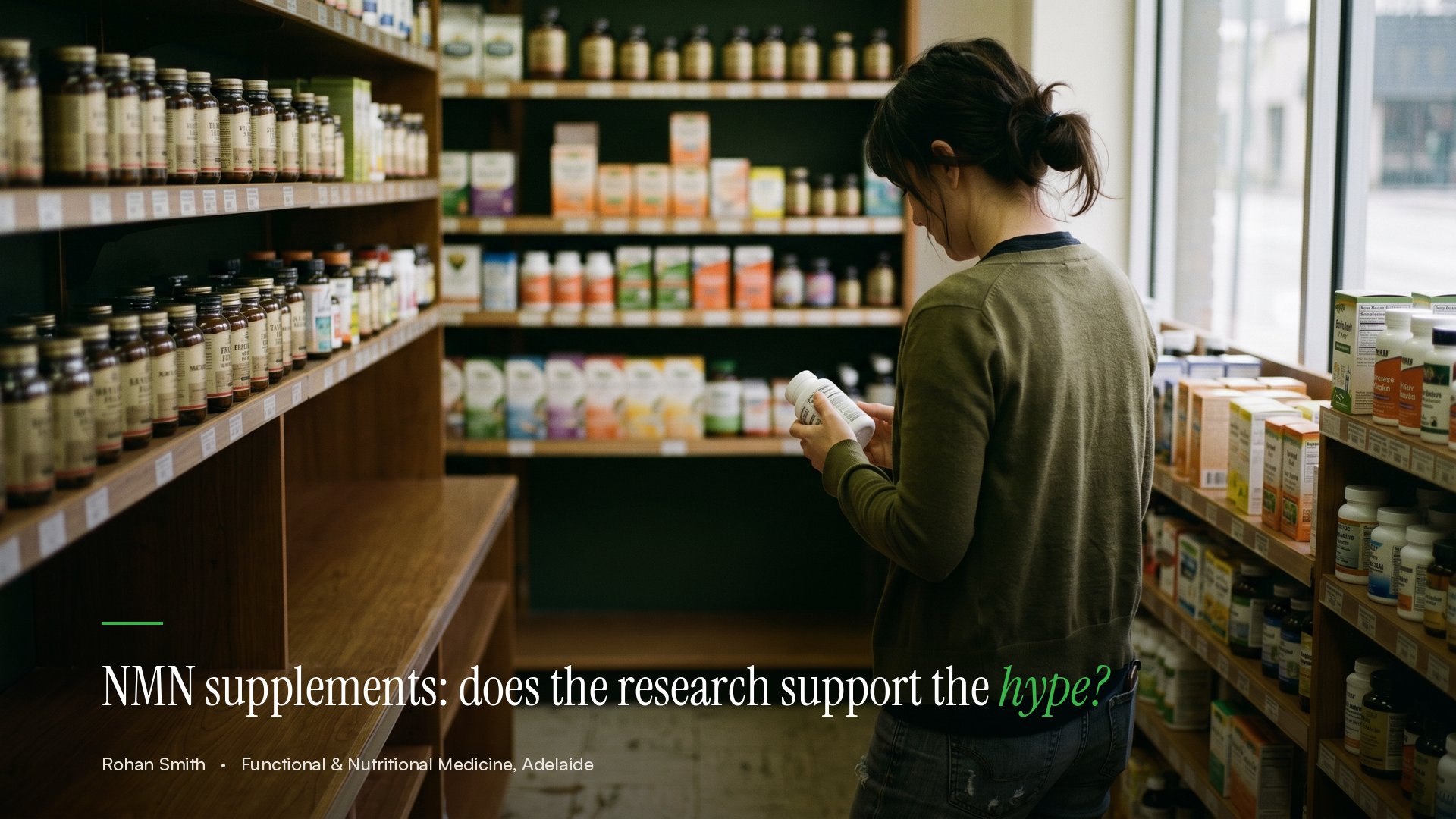
NMN now sits on health-food shop shelves and arrives in clinic as a direct question: "Should I be taking NMN?" The surge has less to do with clinical breakthroughs than with marketing, which has packaged NMN into the longevity story alongside striking laboratory findings in mice. The useful question is not "is NMN trending" but "what have the human trials found."
What the human research shows
It does raise NAD+ in the blood
This is the most consistent finding. A randomised, double-blind, placebo-controlled trial in healthy adults found twelve weeks of oral NMN significantly increased NAD+ in whole blood, with no serious adverse effects.[3] A larger multicentre, dose-ranging trial found NMN raised blood NAD+ across every dose group compared with placebo,[4] and an open-label study in middle-aged men showed NAD+ rising inside immune cells over eight weeks.[5] The harder question is whether that change produces something a person can feel.
Metabolic outcomes: one positive signal, not a settled case
The most widely cited NMN trial, published in Science in 2021, found that in overweight and obese postmenopausal women with prediabetes, ten weeks of oral NMN improved insulin sensitivity in skeletal muscle, though not in whole-body glucose tolerance, body weight or muscle NAD+ content itself.[6] An eight-week study in middle-aged men found a modest drop in post-meal insulin only in the subgroup who started with elevated responses.[5] A 2024 systematic review and meta-analysis of eight randomised trials found short-term NMN did not improve markers of glucose control or the lipid profile.[7]
Physical performance: encouraging in places, absent in others
In amateur runners, six weeks of NMN combined with training improved aerobic capacity at the higher doses tested.[8] The multicentre trial reported longer six-minute walk distances in the NMN groups,[4] and a small trial in healthy older men saw NAD+ rise alongside preliminary improvements in grip strength and gait speed.[9] But a randomised trial in older adults found NMN raised blood NAD+ yet showed no significant difference from placebo on its primary outcome, a stepping test,[10] and a twelve-week arterial-stiffness trial raised a related blood marker without significantly improving the stiffness measure itself.[11] A 2024 systematic review of NMN performance trials called the gains in strength and aerobic measures a non-significant trend, not a clear effect.[15]
The animal-versus-human gap
Much of the excitement traces back to rodent studies, where NAD+ precursors have been linked to improvements in metabolism, vascular function and other markers.[1] But mice are not small people, and supplements that look transformative in a mouse routinely produce smaller or absent effects in humans. A recent expert review of NAD+ precursors in human ageing made the same point: the clinical evidence remains limited, and the strongest claims have outpaced the human data.[12]
Animal data versus human data
A side-by-side look at where NMN's reputation comes from and what controlled human trials have actually established.
| Question | Animal studies | Human trials |
|---|---|---|
| Raises NAD+ | Yes, consistently across tissues | Yes — reliably raises NAD+ in whole blood |
| Energy and metabolism | Broad improvements reported in metabolic markers | One positive insulin-sensitivity trial; meta-analysis finds small, inconsistent effects |
| Physical performance | Improved endurance and function in aged mice | Mixed — some walk-test and aerobic gains, some trials show no primary-outcome change |
| Ageing and lifespan | Suggestive findings on healthspan markers | No long-term human data on ageing outcomes |
| Strength of evidence | Plentiful but not directly applicable to people | Limited, small trials, short duration |
The gap in this table is the whole story. NMN reliably does the biochemical thing it is meant to do. Whether that produces benefits people can feel, over years rather than weeks, remains an open question the current human evidence cannot answer.
The regulatory and quality reality
NMN's regulatory status has been genuinely contested. The US Food and Drug Administration moved in 2022 to exclude NMN from the dietary-supplement category, then reversed that position in September 2025, a back-and-forth that shows how new the compound is and how unsettled its oversight remains. In Australia, NMN is regulated by the Therapeutic Goods Administration, and it is not one of the established, low-risk permitted ingredients that ordinary listed vitamins use.
The quality question may matter more day to day. One analysis of NMN brands with high online market share found the majority failed to meet their labelled NMN claim, and some contained little or no detectable NMN at all.[13] NMN is also chemically unstable and can degrade with poor storage. A buyer faces a real risk of paying for a product that does not contain what it says, so a certificate of analysis from independent testing is a fair thing to ask for.
The functional medicine take
None of this means NMN is worthless. It is a legitimate area of research, and the short-term safety data so far look reasonable in trials using a range of doses,[14] with a recent review of the human clinical trials drawing the same cautious picture.[16] The problem is the framing: the idea that a precursor supplement is the answer to low energy and ageing.
When someone is exhausted, the more useful question is not "what can I add" but "what is draining the system." NAD+ is consumed heavily by the cellular response to chronic inflammation, by DNA damage, and by the metabolic stress of poorly controlled blood sugar.[1] Alcohol, broken sleep and nutrient shortfalls all sit upstream of how the body makes and uses energy, and a capsule does not address any of those. The same logic applies when low energy shows up as brain fog and mood changes rather than physical tiredness.
Functional medicine starts from assessment and testing. Persistent fatigue has many possible drivers, from thyroid function to iron status to undiagnosed sleep disorders, worth identifying before reaching for a longevity supplement. The chronic fatigue and burnout page explains how we approach it, and functional testing sets out the investigations.
So the hype has run ahead of the research. NMN does something measurable to NAD+, but the leap from that to slowing ageing or restoring energy is not yet supported by strong human evidence. Right now it is a maybe, and a maybe is not worth more than addressing the things genuinely draining you.
Key Insights
Frequently Asked Questions
Does NMN actually raise NAD+ levels?
Yes, this is the most consistent finding in the human research. Randomised, placebo-controlled trials have shown that oral NMN can significantly increase NAD+ measured in whole blood, with the rise typically appearing within about four weeks. What is far less certain is whether raising blood NAD+ produces benefits a person can actually feel, such as more energy or slower ageing. Those clinical outcomes are where the evidence becomes mixed and inconclusive.
Is NMN proven to slow ageing?
No. Most of the dramatic anti-ageing findings come from rodent studies, which do not reliably predict effects in people. There is no long-term human data showing NMN slows ageing or extends healthy lifespan. Human trials so far have been small and short, generally weeks to a few months. NMN is an interesting research compound, but the claim that it slows ageing has run well ahead of the actual human evidence.
Is NMN safe to take?
Short-term human trials, using a range of doses over periods of weeks to a few months, have generally reported NMN to be well tolerated without serious adverse effects. However, long-term safety data simply do not exist yet. It is also worth discussing any supplement with a practitioner who knows your health history, particularly if you have an existing condition or take medication. Safety in a short trial is not the same as a guarantee over years of daily use.
Why are NMN products so variable in quality?
NMN is a relatively new and chemically unstable compound, and oversight of supplements varies. Independent testing of NMN products has repeatedly found that many contain far less NMN than their label claims, and some have contained little or none at all. Poor handling and storage can also degrade the compound. If you do choose to try NMN, asking for a third-party certificate of analysis is a reasonable way to check that the product contains what it states.
Should I take NMN for low energy?
From a functional medicine perspective, a precursor supplement is not the first place to look. Persistent fatigue has many possible drivers, including thyroid function, iron status, blood sugar regulation, sleep disorders, chronic inflammation and nutrient shortfalls. These are worth identifying through assessment and testing before reaching for a longevity supplement. NMN does not address the things that genuinely drain energy, and a capsule cannot make the lifestyle and physiological changes that often matter most.
Ready to find answers?
If you are tired of guessing what is behind your fatigue, a proper assessment can replace the supplement lottery with a clear picture of what your body actually needs.
References
- Covarrubias AJ, Perrone R, Grozio A, Verdin E. NAD+ metabolism and its roles in cellular processes during ageing. Nat Rev Mol Cell Biol. 2021;22(2):119–141. doi:10.1038/s41580-020-00313-x
- Covarrubias AJ, Kale A, Perrone R, et al. Senescent cells promote tissue NAD+ decline during ageing via the activation of CD38+ macrophages. Nat Metab. 2020;2(11):1265–1283. doi:10.1038/s42255-020-00305-3
- Okabe K, Yaku K, Uchida Y, et al. Oral administration of nicotinamide mononucleotide is safe and efficiently increases blood nicotinamide adenine dinucleotide levels in healthy subjects. Front Nutr. 2022;9:868640. doi:10.3389/fnut.2022.868640
- Lin Y, Maier AB, Tao R, et al. The efficacy and safety of β-nicotinamide mononucleotide (NMN) supplementation in healthy middle-aged adults: a randomized, multicenter, double-blind, placebo-controlled, parallel-group, dose-dependent clinical trial. GeroScience. 2023;45(1):29–43. doi:10.1007/s11357-022-00705-1
- Yamaguchi S, Irie J, Mitsuishi M, et al. Safety and efficacy of long-term nicotinamide mononucleotide supplementation on metabolism, sleep, and nicotinamide adenine dinucleotide biosynthesis in healthy, middle-aged Japanese men. Endocr J. 2024;71(2):153–169. doi:10.1507/endocrj.EJ23-0431
- Yoshino M, Yoshino J, Kayser BD, et al. Nicotinamide mononucleotide increases muscle insulin sensitivity in prediabetic women. Science. 2021;372(6547):1224–1229. doi:10.1126/science.abe9985
- Chen F, Zhou D, Kong APS, et al. Effects of nicotinamide mononucleotide on glucose and lipid metabolism in adults: a systematic review and meta-analysis of randomised controlled trials. Curr Diab Rep. 2024;25(1):4. doi:10.1007/s11892-024-01557-z
- Liao B, Zhao Y, Wang D, Zhang X, Hao X, Hu M. Nicotinamide mononucleotide supplementation enhances aerobic capacity in amateur runners: a randomized, double-blind study. J Int Soc Sports Nutr. 2021;18(1):54. doi:10.1186/s12970-021-00442-4
- Igarashi M, Nakagawa-Nagahama Y, Miura M, et al. Chronic nicotinamide mononucleotide supplementation elevates blood nicotinamide adenine dinucleotide levels and alters muscle function in healthy older men. npj Aging. 2022;8(1):5. doi:10.1038/s41514-022-00084-z
- Morifuji M, Higashi S, Ebihara S, Nagata M. Ingestion of β-nicotinamide mononucleotide increased blood NAD levels, maintained walking speed, and improved sleep quality in older adults in a double-blind randomized, placebo-controlled study. GeroScience. 2024;46(5):4671–4688. doi:10.1007/s11357-024-01204-1
- Katayoshi T, Uehata S, Nakashima N, et al. Nicotinamide adenine dinucleotide metabolism and arterial stiffness after long-term nicotinamide mononucleotide supplementation: a randomized, double-blind, placebo-controlled trial. Sci Rep. 2023;13(1):2786. doi:10.1038/s41598-023-29787-3
- Nature Metabolism. NAD+ precursor supplementation in human ageing: clinical evidence and challenges. Nat Metab. 2025. doi:10.1038/s42255-025-01387-7
- Fukamizu Y, Uchida Y, Shigekawa A, et al. Safety evaluation of β-nicotinamide mononucleotide oral administration in healthy adult men and women. Sci Rep. 2022;12(1):14442. doi:10.1038/s41598-022-18272-y
- Irie J, Inagaki E, Fujita M, et al. Effect of oral administration of nicotinamide mononucleotide on clinical parameters and nicotinamide metabolite levels in healthy Japanese men. Endocr J. 2020;67(2):153–160. doi:10.1507/endocrj.EJ19-0313
- Wen J, Syed B, Kim S, et al. Improved physical performance parameters in patients taking nicotinamide mononucleotide (NMN): a systematic review of randomized control trials. Cureus. 2024;16(8):e65961. doi:10.7759/cureus.65961
- Song Q, Zhou X, Xu K, Liu S, Zhu X, Yang J. The safety and antiaging effects of nicotinamide mononucleotide in human clinical trials: an update. Adv Nutr. 2023;14(6):1416–1435. doi:10.1016/j.advnut.2023.08.008