
Are Oxalates Causing Your Pain?
Quick Answer
Oxalates are naturally occurring organic compounds found in many plant-based foods and produced internally by the liver. In susceptible individuals, excess oxalates may bind with calcium to form calcium oxalate crystals, potentially contributing to kidney stone formation, musculoskeletal pain, bladder irritation, and digestive discomfort. Gut microbiome health, hydration, and mineral balance are key factors that influence oxalate metabolism and excretion.
Understanding how oxalates affect the body can help guide appropriate dietary and gut-focused strategies for those experiencing unexplained inflammatory symptoms.
At a Glance
- Calcium oxalate crystals are the most common type of kidney stone, accounting for approximately 70-80% of all renal calculi according to research published in the Journal of Clinical Investigation.
- The gut bacterium Oxalobacter formigenes plays a key role in oxalate degradation, and its absence may be associated with increased urinary oxalate levels.
- Both dietary intake and endogenous hepatic production contribute to total body oxalate burden, meaning dietary restriction alone may not fully resolve symptoms.
- Consuming adequate calcium with meals can bind dietary oxalates in the gastrointestinal tract, reducing intestinal absorption and urinary excretion.
- Aggressive or sudden removal of high-oxalate foods may paradoxically worsen symptoms through oxalate dumping, making gradual reduction under clinical guidance preferable.
What Are Oxalates?
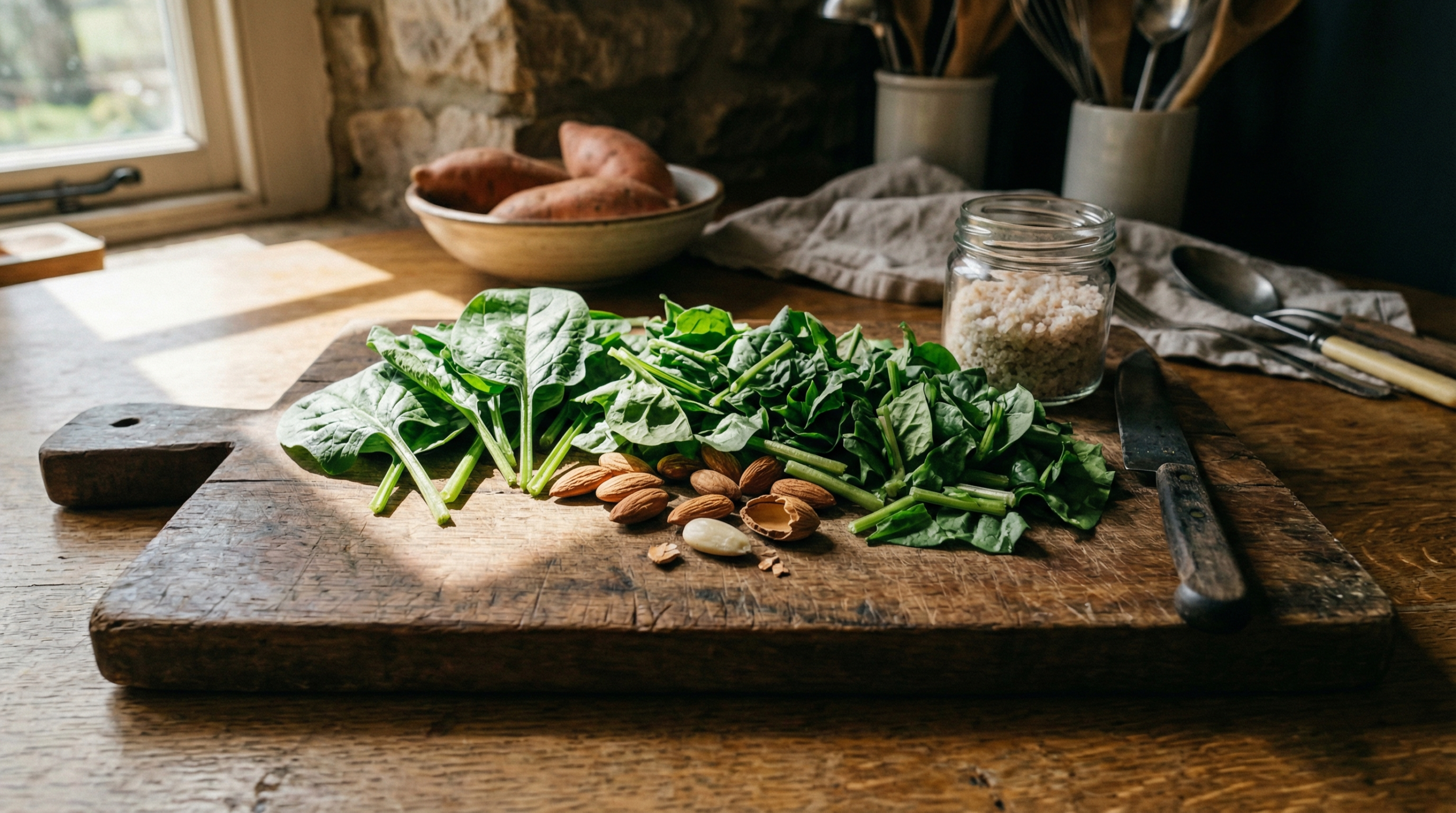
Oxalic acid (C2H2O4) is one of the most common organic acids found in the plant kingdom, present in foods such as spinach, almonds, sweet potatoes, rhubarb, and dark chocolate. Research by Holmes, Goodman, and Assimos published in Kidney International (2001) demonstrated that dietary oxalate may contribute between 24-53% of urinary oxalate in healthy individuals. The body also produces oxalates endogenously through hepatic metabolism, primarily via glyoxylate pathways. In most individuals, oxalates are safely eliminated through renal excretion. However, when intake or internal production exceeds the body’s capacity to excrete them, oxalates can accumulate and bind with minerals such as calcium, forming insoluble calcium oxalate crystals.
How Oxalates Affect the Body
Excess calcium oxalate crystal formation is the primary mechanism by which oxalates may contribute to tissue irritation and inflammatory responses. Research by Coe, Evan, and Worcester published in the Journal of Clinical Investigation (2005) established that calcium oxalate supersaturation in urine is a key driver of nephrolithiasis. Beyond kidney stones, oxalate crystals may deposit in other tissues, potentially triggering localised inflammatory cascades.
| Symptom Area | Potential Oxalate-Related Presentation | Mechanism |
|---|---|---|
| Renal system | Calcium oxalate kidney stones | Crystal supersaturation in urine |
| Urinary tract | Bladder irritation, urinary discomfort | Mucosal irritation from oxalate crystals |
| Musculoskeletal | Joint pain, stiffness, connective tissue discomfort | Crystal-induced inflammatory response |
| Digestive system | Bloating, IBS-like symptoms | Gut dysbiosis and impaired oxalate degradation |
| Systemic | Fatigue and generalised inflammation | Broader metabolic and immune activation |
Some individuals also report fatigue alongside chronic inflammatory symptoms, which may overlap with broader metabolic or stress-related patterns commonly seen in chronic fatigue.
Who Is More Likely to Be Affected?
Certain clinical populations demonstrate significantly higher susceptibility to oxalate-related complications, as documented in research by Nasr and D’Agati in the Clinical Journal of the American Society of Nephrology (2018). Most people tolerate dietary oxalates without issue, but oxalate-related problems are more commonly observed in individuals with specific risk factors.
| Risk Factor | Relevance to Oxalate Sensitivity |
|---|---|
| Recurrent kidney stone history | Indicates pre-existing tendency toward calcium oxalate supersaturation |
| Fat malabsorption or inflammatory bowel disease (IBD) | Unabsorbed fatty acids bind calcium, leaving more free oxalate for absorption |
| Previous bariatric surgery (e.g., Roux-en-Y gastric bypass) | Altered intestinal anatomy may increase enteric oxalate absorption |
| Gut dysbiosis or reduced microbial diversity | Loss of oxalate-degrading bacteria such as Oxalobacter formigenes |
The gut microbiome plays an important role in oxalate degradation. Research by Hatch and Freel published in Urological Research (2005) demonstrated that intestinal transport mechanisms and microbial diversity significantly influence the body’s capacity to break down and eliminate oxalates efficiently. Disruption to species such as Oxalobacter formigenes, Lactobacillus, and Bifidobacterium may reduce oxalate-degrading capacity.
Where Do Oxalates Come From?
Dietary and endogenous sources both contribute to total body oxalate load, making a comprehensive assessment essential for susceptible individuals.
Dietary Sources
| High-Oxalate Food | Approximate Oxalate Content (mg per serving) |
|---|---|
| Spinach (cooked, 100g) | 750-900 |
| Almonds (30g) | 120-150 |
| Rhubarb (100g) | 500-600 |
| Sweet potato (100g) | 140-300 |
| Dark chocolate (30g) | 90-120 |
| Beets (100g) | 150-200 |
| Cashews (30g) | 50-70 |
Internal Production
Oxalates are also produced by the liver during normal metabolic processes, primarily through the glyoxylate and ascorbate (vitamin C) pathways. Research by Holmes and Assimos in Urological Research (2004) demonstrated that endogenous production may account for a significant proportion of urinary oxalate. This means dietary restriction alone may not fully address oxalate burden in susceptible individuals, particularly those with primary hyperoxaluria or genetic variants affecting glyoxylate metabolism.
Do You Need a Low-Oxalate Diet?
A low-oxalate diet is not universally recommended and may be unnecessary for individuals with normal renal function and oxalate metabolism. However, for individuals with documented oxalate sensitivity, recurrent calcium oxalate nephrolithiasis, or enteric hyperoxaluria, a gradual and clinically guided approach may be beneficial.
| Strategy | Rationale |
|---|---|
| Gradual reduction of high-oxalate foods | Avoids oxalate dumping and symptom flares associated with abrupt elimination |
| Calcium intake with meals | Binds oxalates in the gastrointestinal tract, reducing intestinal absorption (Jiang et al., AJCN, 2010) |
| Gut health support | Restores oxalate-degrading microbiota where dysbiosis is suspected |
| Adequate hydration (2-3L daily) | Supports renal excretion and reduces urinary oxalate concentration |
| Targeted nutrients (vitamin B6, magnesium, citrate) | Vitamin B6 (pyridoxine) may reduce endogenous oxalate production; magnesium and citrate may inhibit crystal formation (Ferraro et al., JASN, 2016) |
These strategies are commonly implemented within a broader functional medicine framework that considers digestive health, nutrient status, and metabolic individuality.
When to Consider Testing
Clinical assessment of oxalate metabolism may be warranted when symptoms persist despite standard dietary modifications, or in the context of recurrent calcium oxalate kidney stones. Testing should always be interpreted alongside clinical history and may include urinary oxalate and citrate levels, comprehensive digestive stool analysis (CDSA), and organic acids testing (OAT). Genetic and methylation-related factors, such as those explored in MTHFR methylation, may be relevant in selected cases where primary hyperoxaluria or variants in the AGXT gene (alanine-glyoxylate aminotransferase) are suspected.
Next Steps
- Assess your risk factors: Review your history for recurrent kidney stones, digestive symptoms, fat malabsorption, or gut dysbiosis that may increase oxalate sensitivity.
- Consider gradual dietary adjustments: If oxalate sensitivity is suspected, work with a practitioner to implement a guided, gradual reduction rather than sudden elimination of high-oxalate foods.
- Explore personalised testing: Urinary markers, digestive assessment, and metabolic evaluation can help determine whether oxalates are a significant contributor to your symptoms.
Frequently Asked Questions
Key Insights
- Oxalates are common dietary and metabolic compounds and are not inherently harmful.
- Problems tend to arise only in susceptible individuals with impaired breakdown or excretion capacity.
- Gut health, hydration, and mineral balance play central roles in oxalate handling.
- Aggressive restriction is rarely necessary and may worsen symptoms if poorly managed.
Citable Takeaways
- Calcium oxalate stones account for approximately 70-80% of all kidney stones, making oxalate metabolism a key area of investigation for individuals with recurrent nephrolithiasis (Coe et al., Journal of Clinical Investigation, 2005).
- Dietary oxalate may contribute between 24-53% of total urinary oxalate excretion, with endogenous hepatic production accounting for the remainder (Holmes, Goodman & Assimos, Kidney International, 2001).
- Consuming calcium with oxalate-rich meals can significantly reduce urinary oxalate excretion by binding oxalates in the gastrointestinal tract before absorption (Jiang et al., American Journal of Clinical Nutrition, 2010).
- The gut bacterium Oxalobacter formigenes plays a significant role in intestinal oxalate degradation, and its absence has been associated with increased risk of calcium oxalate stone formation (Hatch & Freel, Urological Research, 2005).
- Vitamin B6 (pyridoxine) supplementation may help reduce endogenous oxalate synthesis, with observational data from Ferraro et al. (Journal of the American Society of Nephrology, 2016) suggesting an inverse association between B6 intake and kidney stone risk in women.
Get to the Root of Unexplained Pain
If you are dealing with unexplained pain, recurrent kidney stones, or inflammatory symptoms and suspect oxalates may be contributing, personalised assessment is essential. At Elemental Health and Nutrition, we take a structured nutrition and gut-focused approach — supported by targeted testing and supplementation where appropriate — to identify whether oxalates are relevant in your case and how best to address them safely.
References
- Coe FL et al. Kidney stone disease. J Clin Invest. 2005 Oct;115(10):2598-608. https://doi.org/10.1172/JCI26662
- Holmes RP, Assimos DG. The impact of dietary oxalate on kidney stone formation. Urol Res. 2004 Oct;32(5):311-6. https://doi.org/10.1007/s00240-004-0435-7
- Noonan SC, Savage GP. Oxalate content of foods and its effect on humans. Asia Pac J Clin Nutr. 1999;8(1):64-74. https://pubmed.ncbi.nlm.nih.gov/24393738/
- Lieske JC et al. Diet, but not oral probiotics, effectively reduces urinary oxalate excretion. Kidney Int. 2005 Oct;68(4):1805-13. https://doi.org/10.1111/j.1523-1755.2005.00599.x
- Hoppe B, Leumann E. Diagnostic and therapeutic approaches in patients with primary hyperoxalurias. Nat Rev Nephrol. 2009 Aug;5(8):467-75. https://doi.org/10.1038/nrneph.2009.104
- Siener R, Hesse A. The effect of a vegetarian and different omnivorous diets on urinary risk factors for uric acid stone formation. Eur J Nutr. 2003 Dec;42(6):332-7. https://doi.org/10.1007/s00394-003-0428-7
- Holmes RP, Goodman HO, Assimos DG. Contribution of dietary oxalate to urinary oxalate excretion. Kidney Int. 2001 Jan;59(1):270-6. https://doi.org/10.1046/j.1523-1755.2001.00488.x
- Hatch M, Freel RW. Intestinal transport of an obdurate anion: oxalate. Urol Res. 2005 Feb;33(1):1-16. https://doi.org/10.1007/s00240-004-0444-6
- Jiang J et al. Impact of dietary calcium and oxalate on urinary oxalate and calcium oxalate supersaturation. Am J Clin Nutr. 2010 Apr;91(4):940-7. https://doi.org/10.3945/ajcn.2009.28881
- Goldfarb DS. Dietary factors in the pathogenesis and prophylaxis of calcium oxalate kidney stones. Kidney Int. 2009 Jul;76(7):713-20. https://doi.org/10.1038/ki.2009.213
- Lieske JC et al. Use of a probiotic to decrease enteric hyperoxaluria. Kidney Int. 2005 Sep;68(3):1244-9. https://doi.org/10.1111/j.1523-1755.2005.00580.x
- Weaver CM, Heaney RP. Calcium. In: Modern Nutrition in Health and Disease. 11th ed. Philadelphia: Lippincott Williams & Wilkins; 2014:132-151.
- Ferraro PM et al. Intake of vitamins B6 and C and the risk of kidney stones in women. J Am Soc Nephrol. 2016 Jun;27(6):2109-2117. https://doi.org/10.1681/ASN.2015020188
- Nasr SH, D’Agati VD. Oxalate nephropathy: a review. Clin J Am Soc Nephrol. 2018 Dec 7;13(12):1891-1899. https://doi.org/10.2215/CJN.07450718
- Mitchell T et al. Dietary oxalate and kidney stone formation. Am J Physiol Renal Physiol. 2019 Mar 1;316(3):F409-F413. https://doi.org/10.1152/ajprenal.00379.2018