Sleep apnoea in women: the fatigue that gets blamed on everything else
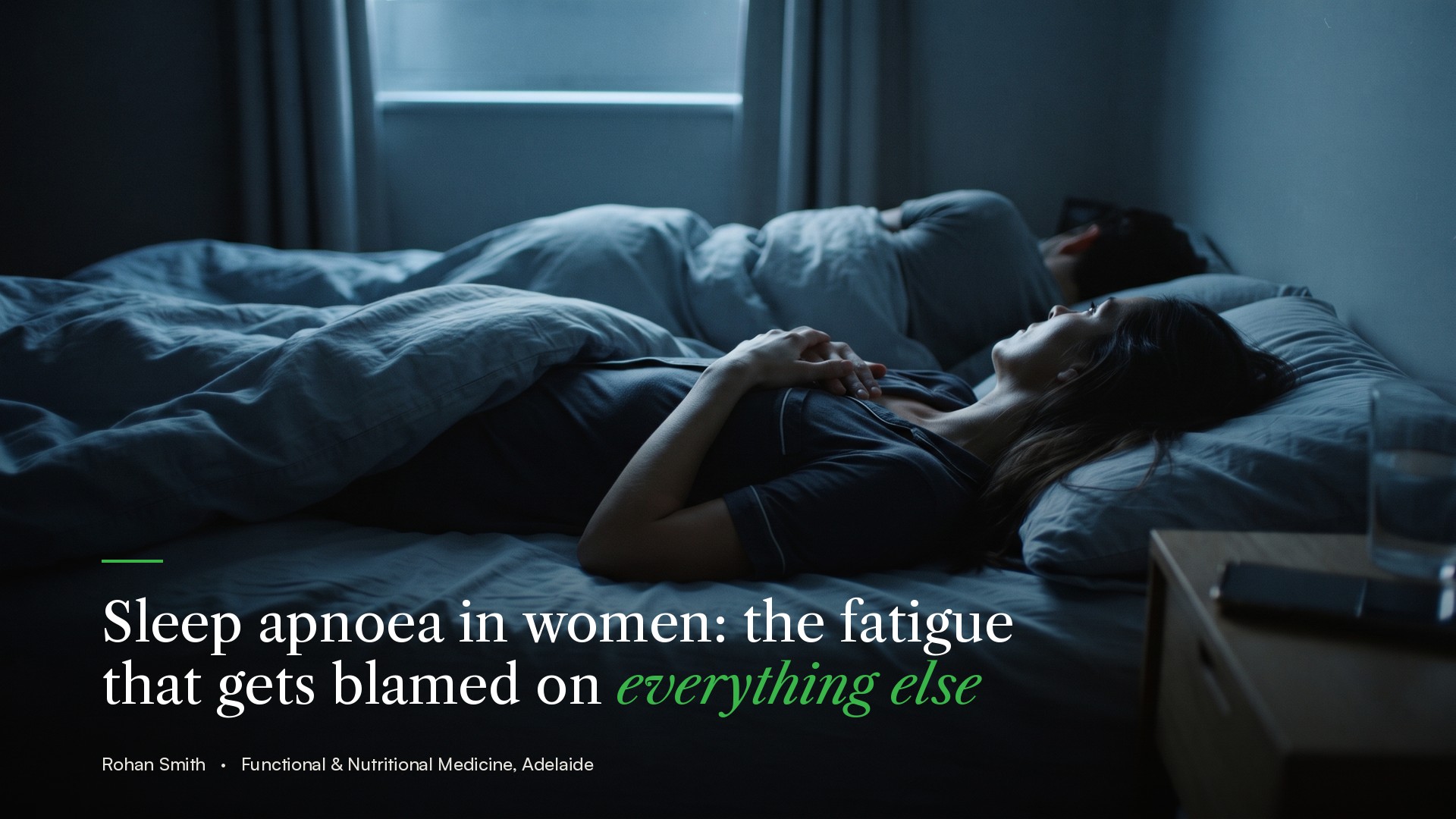
Sleep apnoea in women: the fatigue that gets blamed on everything else
Obstructive sleep apnoea is a condition where the upper airway repeatedly narrows or closes during sleep, interrupting breathing and fragmenting sleep architecture.[18] It is widely understood as a condition of overweight, middle-aged men who snore loudly, and that picture is where a great deal of diagnostic difficulty begins for women.
Women frequently present with a different symptom cluster. Instead of loud snoring and witnessed breathing pauses, they more often report persistent fatigue that sleep does not resolve, difficulty staying asleep, morning headache, low mood, and reduced concentration.[3] These symptoms overlap almost completely with depression, anxiety, an underactive thyroid, iron deficiency, perimenopause, and chronic fatigue, so the airway is often the last thing anyone considers.
The consequence is measurable. Women are diagnosed at a fraction of the rate population studies suggest they are affected, and reviews describe a substantial share remaining undiagnosed.[1][6] Because untreated sleep apnoea is associated with cardiovascular and metabolic consequences, that delay carries a cost beyond feeling tired.[5]
The picture most people carry is a picture of men
Ask most people to describe sleep apnoea and you get a consistent portrait: an older man, overweight, snoring loudly enough to be heard through a wall, occasionally stopping breathing while his partner counts. That portrait is not wrong, only incomplete, and it was built from the population studied first and studied most.
Women have been consistently under-represented in obstructive sleep apnoea studies, which shapes what clinicians recognise as typical.[4] When the reference picture comes from male cohorts, the female presentation reads as atypical, and atypical presentations get investigated later.[16]
The numbers show the gap. Community estimates put sleep-disordered breathing in around 17% of women aged 30 to 70, rising with age and body weight.[2] Global burden estimates place close to a billion adults in the affected range worldwide.[17] National registry work, by contrast, finds women make up only about a quarter of people actually diagnosed.[1] A recent review of diagnosis and treatment in women estimates that a large majority of affected women remain undiagnosed.[6] The condition is not as rare in women as the clinic numbers imply. It is quieter, and quieter conditions get missed.
Why the symptoms point somewhere else
The picture in women tends to be less dramatic and more diffuse. Snoring may be softer or unwitnessed. What women more often bring to an appointment is exhaustion that does not lift with a full night in bed, waking at 3am unable to get back to sleep, a dull headache on waking, low mood, and slipping concentration.[3][7][19]
Read that list without the airway in mind and it maps onto depression, an underactive thyroid, iron deficiency, perimenopause, or post-viral fatigue. Each is worth investigating, and often one is genuinely part of the picture. The difficulty is that finding a plausible explanation tends to end the search, and the airway never gets examined.
The mood overlap runs in both directions. A systematic review and meta-analysis of mood disorders in obstructive sleep apnoea found meaningful associations between them.[12] Fragmented sleep affects mood regulation, and low mood affects sleep. A woman treated for depression whose underlying sleep fragmentation is never addressed may improve only partially, and that partial response is easy to read as treatment-resistant depression rather than an unexamined cause.
The same reasoning applies to brain fog and mood generally: a symptom with an obvious psychological reading still deserves a physiological screen before that reading is accepted as complete.
The screening tools were built around men
Most people are first assessed using a short questionnaire. These instruments are quick and useful, and they were largely validated in samples where men predominated. Their weighting reflects that.
Widely used tools ask about loud snoring, observed apnoeas, and daytime sleepiness. A woman whose main experience is unrefreshing sleep and night waking, with no partner reporting pauses, can answer honestly and score below the referral threshold. Reviews of screening performance in women have raised this concern, including one on how the Epworth Sleepiness Scale behaves in women.[8][14] Sleepiness and fatigue are not the same experience, and the questionnaires largely ask about sleepiness.
Work is underway to develop sex-specific screening approaches.[13] Until those are in routine use, a low questionnaire score in a woman with unexplained fatigue is weak evidence of absence rather than reassurance.
How the same condition tends to present
Generalisations with wide individual variation. Many women do snore loudly, and many men present atypically. The point is which pattern prompts a referral.
| FEATURE | CLASSIC PATTERN | COMMON IN WOMEN |
|---|---|---|
| Main complaint | Daytime sleepiness, falling asleep easily | Fatigue that rest does not resolve |
| Sleep pattern | Sleeps through, wakes unrefreshed | Difficulty staying asleep, early waking |
| Snoring | Loud, disruptive, reported by others | Softer or absent; often unwitnessed |
| Associated symptoms | Witnessed pauses, choking or gasping | Morning headache, low mood, poor concentration |
| Study findings | Events across all sleep stages | REM-related and positional events |
| Usual first label | Suspected sleep apnoea | Depression, thyroid, anaemia, perimenopause |
Perimenopause removes part of the protective effect
Risk rises noticeably around the menopausal transition, with longitudinal midlife-cohort data showing sleep-disordered breathing increasing through this stage.[10] Reviews of menopause and hormone therapy describe the same pattern.[9]
Progesterone acts as a respiratory stimulant and appears to support upper airway muscle tone during sleep, while oestrogen influences fat distribution and soft tissue. As both decline, part of that protection is lost, and shifting body composition compounds it.
The timing creates a diagnostic trap. Broken sleep, night sweats, fatigue and mood changes are all expected features of perimenopause, so the hormonal explanation is reasonable and usually correct in part. It can also sound complete enough to end the enquiry. Where fatigue and unrefreshing sleep persist after other aspects of hormonal change have been addressed, the airway is worth examining. This sits alongside the broader picture of how women's sleep differs across the lifespan.
Why it matters beyond feeling tired
Untreated obstructive sleep apnoea is associated with hypertension, impaired glucose regulation, and cardiovascular disease. A review in Maturitas framed it as a forgotten cardiovascular risk factor in women, arguing the diagnostic gap becomes an unaddressed risk burden.[5]
The metabolic association matters clinically. Repeated overnight oxygen dips and sleep fragmentation drive sympathetic activation and are associated with insulin resistance. A meta-analysis of continuous positive airway pressure therapy in people with obstructive sleep apnoea and insulin resistance examined progression to type 2 diabetes, indicating the metabolic dimension is treatable rather than incidental.[11]
Registry data also show long-term consequences differing by sex, including effects on work capacity.[15] None of this means every tired woman has sleep apnoea. It means that when fatigue has resisted the usual explanations, leaving the airway unexamined is a gap worth closing, particularly where chronic fatigue has become the working label.
What a considered assessment looks like
A useful assessment starts with the right questions. Rather than leading with snoring, it asks whether sleep is restorative, what night waking looks like, whether there is morning headache, and how symptoms have tracked against hormonal changes. It notes nasal obstruction, jaw and airway structure, reflux, and alcohol timing. Expert consensus work on obstructive sleep apnoea in women recommends exactly this kind of sex-aware history rather than a generic checklist.[20]
Where suspicion is reasonable, the definitive step is a sleep study arranged through a GP or sleep physician, and home-based studies have made this far more accessible. When results come back, the useful question is not only the overall apnoea-hypopnoea index but whether events clustered in REM, whether they were positional, and how oxygen saturation behaved.
It is also worth confirming the conditions that share this symptom picture rather than assuming they were excluded. Thyroid function, iron studies including ferritin, and markers of glucose regulation are all reasonable, since more than one factor often contributes. Functional testing is useful here for the same reason it is useful elsewhere: it distinguishes between overlapping explanations instead of settling on the first plausible one. Diagnosis and treatment of sleep apnoea sit with a sleep physician; functional medicine works alongside that, not in place of it.
Key Insights
Frequently Asked Questions
Can you have sleep apnoea without snoring?
Yes. Snoring is a common feature but not a required one, and it is often softer or absent in women. Many women also sleep alone or have a partner who does not wake to notice it. Assessment should rest on the overall pattern, including unrefreshing sleep, night waking and morning headache, rather than on snoring alone.
Why is sleep apnoea missed more often in women?
Several factors combine. The recognised clinical picture was built largely from male cohorts, women have been under-represented in research, the symptoms overlap heavily with depression, thyroid disease and perimenopause, and standard screening questionnaires emphasise features that are more typical of men. Each factor is small on its own, and together they delay referral.
Does perimenopause cause sleep apnoea?
It does not cause it directly, but risk rises through the menopausal transition. Progesterone supports respiratory drive and upper airway muscle tone, and oestrogen influences body composition, so declining levels remove part of that protection. Because perimenopause also independently disturbs sleep, the two are easily conflated.
My sleep study said mild. Why do I still feel exhausted?
The apnoea-hypopnoea index is an average across the night, so it can understate disruption when events concentrate in REM sleep or in particular sleeping positions, patterns that are more common in women. It is worth reviewing the detail of the study with the reporting physician rather than relying on the severity grade alone.
Should I be tested if I am not overweight?
Body weight is a significant risk factor but not a prerequisite. Airway anatomy, nasal obstruction, jaw structure, hormonal status and age all contribute, and sleep apnoea occurs in women within a healthy weight range. Persistent unrefreshing sleep that has not been explained is reason enough to raise it with your doctor.
Ready to find answers?
If fatigue has been investigated and explained more than once without ever properly improving, it may be worth looking at what happens while you sleep. We work alongside your GP and sleep physician to make sure nothing underneath the tiredness gets missed.
References
- Jennum P, et al. The gender gap in obstructive sleep apnea: unmasking the disproportionate costs on women. Sleep. 2025;48(7):zsaf068. doi:10.1093/sleep/zsaf068
- Peppard PE, Young T, Barnet JH, Palta M, Hagen EW, Hla KM. Increased prevalence of sleep-disordered breathing in adults. American Journal of Epidemiology. 2013;177(9):1006–1014. doi:10.1093/aje/kws342
- Bonsignore MR, Saaresranta T, Riha RL. Sleep disordered breathing: is it different for females? ERJ Open Research. 2015;1(2):00063-2015. doi:10.1183/23120541.00063-2015
- Pien GW, et al. Addressing the underrepresentation of women in studies on obstructive sleep apnea. Sleep. 2025;48(10):zsaf222. doi:10.1093/sleep/zsaf222
- Obstructive sleep apnea syndrome (OSAS) in women: A forgotten cardiovascular risk factor. Maturitas. 2025;192:108170. doi:10.1016/j.maturitas.2024.108170
- Advances in the Diagnosis and Treatment of Obstructive Sleep Apnea in Women. Pulmonary Therapy. 2026. doi:10.1007/s41030-026-00350-5
- Sleep apnea in women: prevalence, symptoms, phenotypes, and treatment. Revue Médicale Suisse. 2025;21(939). doi:10.53738/REVMED.2025.21.939.47832
- What do we know about the Epworth Sleepiness Scale in women? A review of the evidence. Sleep Medicine Reviews. 2026;80:102323. doi:10.1016/j.smrv.2026.102323
- Role of menopause and hormone replacement therapy in sleep-disordered breathing. Sleep Medicine Reviews. 2020;49:101225. doi:10.1016/j.smrv.2019.101225
- Sleep-disordered breathing and the menopausal transition among participants in the Sleep in Midlife Women Study. Menopause. 2017;24(2):157–162. doi:10.1097/GME.0000000000000744
- Abud R, Salgueiro M, Drake L, Reyes T, Jorquera J, Labarca G. Efficacy of continuous positive airway pressure (CPAP) preventing type 2 diabetes mellitus in patients with obstructive sleep apnea hypopnea syndrome and insulin resistance: a systematic review and meta-analysis. Sleep Medicine. 2019;62:14–21. doi:10.1016/j.sleep.2018.12.017
- Mood Disorders and Obstructive Sleep Apnea: A Systematic Review and Meta-Analysis. Journal of Clinical Medicine. 2026;15(14):5478. doi:10.3390/jcm15145478
- Bridging the Gender Gap in Obstructive Sleep Apnea: A Machine Learning Approach to Screening Women. Respiration. 2026. doi:10.1159/000551856
- Sex inequities in sleep disordered breathing. Sleep Medicine. 2026;133:109002. doi:10.1016/j.sleep.2026.109002
- Long-term welfare consequences of sleep apnea in 20–64-year-olds – influence of gender: a nationwide cohort study. Sleep. 2025;48(6):zsaf057. doi:10.1093/sleep/zsaf057
- Wimms A, Woehrle H, Ketheeswaran S, Ramanan D, Armitstead J. Obstructive Sleep Apnea in Women: Specific Issues and Interventions. BioMed Research International. 2016;2016:1764837. doi:10.1155/2016/1764837
- Benjafield AV, et al. Estimation of the global prevalence and burden of obstructive sleep apnoea: a literature-based analysis. The Lancet Respiratory Medicine. 2019;7(8):687–698. doi:10.1016/S2213-2600(19)30198-5
- Levy P, Kohler M, McNicholas WT, et al. Obstructive sleep apnoea syndrome. Nature Reviews Disease Primers. 2015;1:15015. doi:10.1038/nrdp.2015.15
- Evaluation of Obstructive Sleep Apnea in Female Patients. Frontiers in Medicine. 2022;9:826372. PMC8740168
- Expert consensus on the diagnosis and treatment of obstructive sleep apnea in women. Chinese Journal of Tuberculosis and Respiratory Diseases. 2024;47(7). doi:10.3760/cma.j.cn112147-20240206-00072