The racing heart after COVID that keeps getting called anxiety
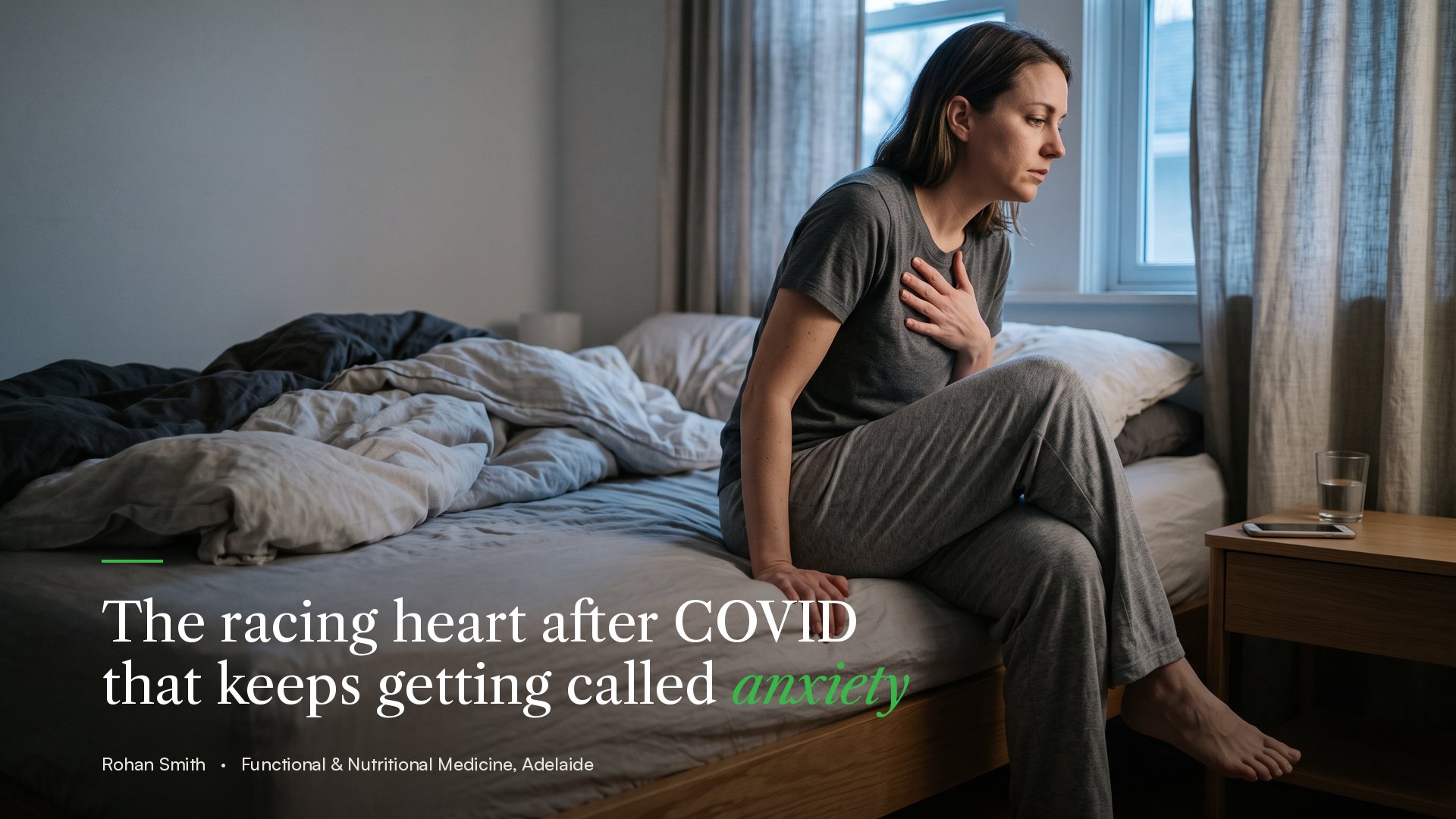
The racing heart after COVID that keeps getting called anxiety
Postural orthostatic tachycardia syndrome, or POTS, is a disorder of the autonomic nervous system: the part of the body that runs heart rate, blood pressure and blood flow without you thinking about it. Consensus criteria define it as a sustained heart rate rise of at least 30 beats per minute within ten minutes of standing or head-up tilt, at least 40 in adolescents aged 12 to 19, with no blood pressure drop to explain it and symptoms lasting three months or more.[1]
Standing is a small circulatory challenge. Gravity pulls roughly half a litre of blood into the legs and abdomen, and the autonomic system should tighten those vessels so blood keeps returning to the heart. In POTS that compensation is incomplete, so the heart speeds up to cover the gap. The tachycardia is the visible part of the problem rather than the problem itself.[8]
Viral illness has long been a recognised trigger, and SARS-CoV-2 pushed a familiar pattern into far more people than usual.[2] In a cohort of more than 284,000 people, the odds of a new POTS diagnosis after infection were around five times higher than after vaccination.[4]
The practical point is that this is measurable. Heart rate and blood pressure recorded lying down, then across ten minutes of standing, is enough to raise or lower the suspicion, and it costs nothing.[9]
What is actually going wrong
Most people notice it as symptoms that only make sense once you connect them. Lightheadedness on standing. A heart that thumps walking up a short flight of stairs. Nausea, poor appetite, bloating. Exhaustion that worsens the longer you stay upright, and relief on lying down. Alongside those sit the cognitive symptoms: losing a word mid-sentence, reading the same paragraph three times.[1]
Several mechanisms produce that same picture, which is why POTS resists one explanation. Many patients have reduced blood volume with a paradoxically low renin and aldosterone response.[10] In others, damage to the small nerve fibres controlling leg blood vessels leaves them unable to tighten on standing.[16] A third group runs high noradrenaline while upright, producing the shakiness, sweating and dread that gets read as panic.[8]
Autoimmunity remains open. Autoantibodies against adrenergic and muscarinic receptors have been reported more often in patients than controls,[14] though later work using standardised methods questioned how well those assays separate the groups.[15] An immune contribution looks plausible in a subset, and no commercial test reliably identifies it.
Why a virus can leave the system stuck on high alert
Post-viral onset was described long before 2020. What changed is scale. Reviews of post-acute COVID-19 consistently list cardiovascular autonomic dysfunction among the recurring features, orthostatic intolerance chief among them.[5] Work from the Australian Dysautonomia and Arrhythmia Research Collaborative and the University of Adelaide documented the same pattern here, including marked impairment in people never hospitalised.[6]
The proposed mechanisms overlap: immune-mediated injury to autonomic nerves, persistent low-grade inflammation, altered small vessel function, and deconditioning after weeks of illness.[2][7] Deconditioning matters in some people, but as the whole story it fails to fit patients who were fit beforehand and stay limited long after returning to activity.
Standing still for ten minutes is most of the test
The step that changes the conversation suits any consulting room. Heart rate and blood pressure are measured after lying quietly, then at intervals across ten minutes of standing. A sustained rise meeting the threshold, with no significant fall in blood pressure, supports the diagnosis. Head-up tilt stays useful in ambiguous cases, and a direct comparison found the two agree well enough that an active stand is a reasonable first step.[9]
Two cautions. One normal reading does not exclude POTS, since the response shifts with hydration, time of day, food and cycle phase. And a wearable showing your heart rate jump on standing is a prompt to get assessed, not a diagnosis.
Four things that feel similar standing up
These overlap in how they feel and separate cleanly on a stand test, which is why the test is worth doing before anything is assumed.
| Pattern | What happens | What separates it |
|---|---|---|
| POTS | Heart rate climbs at least 30 beats per minute within ten minutes upright and stays there; blood pressure holds. | Sustained and reproducible, with no blood pressure drop. |
| Orthostatic hypotension | Blood pressure falls within about three minutes of standing. | The blood pressure drop defines it, and rules POTS out. |
| Inappropriate sinus tachycardia | Resting heart rate is already high lying down, and stays high. | Not driven by posture, so standing adds little. |
| Anxiety or panic | Heart rate rises during episodes, often unrelated to being upright. | Tracks situations, not posture; stand test typically normal. |
| Deconditioning | Heart rate rises on standing and with light effort after inactivity. | Improves predictably with graded activity; POTS improves more slowly. |
Anxiety and POTS are not alternatives, and one does not disprove the other. Living with unpredictable palpitations is genuinely anxiety-provoking, and a person can reasonably have both. The mistake is stopping at the psychological explanation without ever measuring the circulatory one.
Why it gets written off as anxiety
The symptom overlap is close to complete. Racing heart, breathlessness, sweating, trembling, nausea, dizziness, a sense of impending doom: all appear in descriptions of panic and of hyperadrenergic POTS, because in both the sympathetic nervous system is driving hard. Demographics compound it, since POTS predominantly affects young women, whose physical symptoms are more often attributed to psychological causes before being investigated.[3]
That detour is costly. POTS is associated with substantial loss of employment and income.[13] Cognitive symptoms rate among the most disabling features and correlate with orthostatic stress rather than mood.[11][12] If your exhaustion and fogginess have been called stress-related and nobody has measured what your heart does on standing, that is a gap worth closing. Our brain fog and mood and chronic fatigue and burnout pages cover the wider picture.
What is worth checking underneath the diagnosis
A POTS diagnosis names the pattern. It does not explain why this person has it, and several contributors are common and modifiable.
Iron status. Low iron stores have been reported more often in POTS patients than comparison groups, and iron deficiency independently produces fatigue, breathlessness and tachycardia.[18] Ferritin at the low end of the range with a normal haemoglobin is easy to pass over.
Thyroid function. Over- and underactive thyroid both affect heart rate, blood volume and exercise tolerance, and thyroid disease is common in the same demographic. The thyroid and metabolism page covers a fuller panel.
Mast cell activation. A hyperadrenergic pattern with flushing, itching, food and temperature reactivity and unpredictable flares has been described alongside mast cell activation disorders, and responds differently to treatment.[17]
Nutrient status. Deficiencies following prolonged poor appetite, nausea or restricted eating worsen fatigue and cognitive symptoms. These sit within the wider complex chronic patterns we see most, and functional testing is how contributors get separated.
What actually helps
Volume expansion is the foundation of non-drug management. In a controlled crossover study a high-sodium diet lowered standing heart rate, raised total blood volume and reduced standing noradrenaline compared with a low-sodium diet, though values did not reach those of healthy controls.[19] That last detail is the honest version: salt loading helps meaningfully and is not a fix. It also suits some people and not others, particularly with high blood pressure or kidney disease, so the amount belongs with your practitioner rather than a comment section.
Graded exercise begun recumbent or seated has the most consistent support. Rowing, recumbent cycling and swimming build cardiac capacity without the orthostatic load upright work imposes, progressing slowly over months.[20] A UK feasibility trial found supervised rehabilitation deliverable and acceptable, with larger trials still needed to settle the benefit.[21] Pacing matters, and pushing through a flare sets recovery back.
Compression garments over the abdomen and legs reduce venous pooling and can be surprisingly effective for something so unglamorous.[20] Medications are used where these fall short, though evidence specific to post-COVID POTS is limited and largely extrapolated.[22] Prognosis is reasonable: in a long-term outcomes survey most patients reported improvement, even while many continued to have symptoms.[23]
Key Insights
Frequently Asked Questions
How do I know if my racing heart is POTS or anxiety?
The distinguishing feature is posture. In POTS the heart rate rises when you stand and settles when you lie down, reliably and repeatedly. In anxiety the rise tracks situations and thoughts rather than position. A ten-minute stand test, measuring heart rate and blood pressure lying and then standing, separates the two in most cases. It is worth adding that the two can coexist, and that a POTS diagnosis does not mean anxiety was never present.
Can POTS start after COVID even if I was not very sick?
Yes. Autonomic symptoms after SARS-CoV-2 infection have been reported in people who had mild initial illness and were never hospitalised, including in Australian research cohorts. Severity of the acute infection is a poor predictor of who develops post-viral autonomic problems, which is one reason these presentations are often not connected back to the infection that preceded them.
Does POTS go away on its own?
Many people improve substantially over months to years, particularly with consistent volume expansion, graded reconditioning and attention to contributing factors. In a long-term outcomes survey most patients reported improvement, though a proportion continued to have symptoms. Improvement tends to be gradual rather than sudden, and pacing through flares matters more than pushing hard on good days.
Will drinking more water and adding salt fix it?
It helps and it is usually the first thing tried, but the evidence does not support it as a complete answer. In a controlled study a high-sodium diet lowered standing heart rate and raised blood volume compared with a low-sodium diet, yet the response still did not match healthy controls. It is also not suitable for everyone, particularly with high blood pressure or kidney disease, so the amount and the approach should be discussed with your practitioner.
What should I ask my doctor to check?
A lying and standing heart rate and blood pressure recorded over ten minutes is the starting point. Beyond that, iron studies including ferritin, a thyroid panel, full blood count, electrolytes and vitamin B12 are reasonable, since deficiencies and thyroid dysfunction can produce or worsen the same symptoms. If flushing, itching or unpredictable food and temperature reactions are prominent, mast cell involvement is worth raising.
Ready to find answers?
If your heart races when you stand, your energy collapses by mid-afternoon and your bloods keep coming back normal, the next step is measuring what is actually happening rather than guessing at it.
References
- Chung TH, et al. Postural Orthostatic Tachycardia Syndrome (POTS): A Review. JAMA. 2026. doi:10.1001/jama.2026.14809
- Cantrell C, et al. Post-COVID postural orthostatic tachycardia syndrome (POTS): a new phenomenon. Frontiers in Neurology. 2024;15:1297964. doi:10.3389/fneur.2024.1297964
- Shaw BH, et al. The face of postural tachycardia syndrome: insights from a large cross-sectional online community-based survey. Journal of Internal Medicine. 2019;286(4):438–448. doi:10.1111/joim.12895
- Kwan AC, et al. Apparent risks of postural orthostatic tachycardia syndrome diagnoses after COVID-19 vaccination and SARS-CoV-2 infection. Nature Cardiovascular Research. 2022;1(12):1187–1194. doi:10.1038/s44161-022-00177-8
- Bisaccia G, et al. Post-acute sequelae of COVID-19 and cardiovascular autonomic dysfunction: what do we know? Journal of Cardiovascular Development and Disease. 2021;8(11):156. doi:10.3390/jcdd8110156
- Seeley MC, et al. Autonomic dysfunction in post-acute sequelae of COVID-19. European Journal of Internal Medicine. 2024;127:161–163. doi:10.1016/j.ejim.2024.06.023
- Amekran Y, et al. Postural orthostatic tachycardia syndrome and post-acute COVID-19. Global Cardiology Science and Practice. 2022;2022(1-2):e202213. doi:10.21542/gcsp.2022.13
- Fedorowski A. Postural orthostatic tachycardia syndrome: clinical presentation, aetiology and management. Journal of Internal Medicine. 2019;285(4):352–366. doi:10.1111/joim.12852
- Uppal J, et al. Physiological and clinical comparison of active stand and head-up tilt tests in postural orthostatic tachycardia syndrome (POTS). Autonomic Neuroscience. 2025;260:103281. doi:10.1016/j.autneu.2025.103281
- Raj SR, et al. Renin-aldosterone paradox and perturbed blood volume regulation underlying postural tachycardia syndrome. Circulation. 2005;111(13):1574–1582. doi:10.1161/01.CIR.0000160356.97313.5D
- Raj V, et al. Cognitive and psychological issues in postural tachycardia syndrome. Autonomic Neuroscience. 2018;215:46–55. doi:10.1016/j.autneu.2018.03.004
- Tavee J. Current concepts in long COVID-19 brain fog and postural orthostatic tachycardia syndrome. Annals of Allergy, Asthma & Immunology. 2024;133(5):522–530. doi:10.1016/j.anai.2024.08.008
- Bourne KM, et al. Postural orthostatic tachycardia syndrome is associated with significant employment and economic loss. Journal of Internal Medicine. 2021;290(1):203–212. doi:10.1111/joim.13245
- Gunning WT 3rd, et al. Postural orthostatic tachycardia syndrome is associated with elevated G-protein coupled receptor autoantibodies. Journal of the American Heart Association. 2019;8(18):e013602. doi:10.1161/JAHA.119.013602
- Hall J, et al. Detection of G protein-coupled receptor autoantibodies in postural orthostatic tachycardia syndrome using standard methodology. Circulation. 2022;146(8):613–622. doi:10.1161/CIRCULATIONAHA.122.059971
- Haensch CA, et al. Small-fiber neuropathy with cardiac denervation in postural tachycardia syndrome. Muscle & Nerve. 2014;50(6):956–961. doi:10.1002/mus.24245
- Shibao C, et al. Hyperadrenergic postural tachycardia syndrome in mast cell activation disorders. Hypertension. 2005;45(3):385–390. doi:10.1161/01.HYP.0000158259.68614.40
- Jarjour IT, et al. Low iron storage and mild anemia in postural tachycardia syndrome in adolescents. Clinical Autonomic Research. 2013;23(4):175–179. doi:10.1007/s10286-013-0198-6
- Garland EM, et al. Effect of high dietary sodium intake in patients with postural tachycardia syndrome. Journal of the American College of Cardiology. 2021;77(17):2174–2184. doi:10.1016/j.jacc.2021.03.005
- Fu Q, et al. Exercise and non-pharmacological treatment of POTS. Autonomic Neuroscience. 2018;215:20–27. doi:10.1016/j.autneu.2018.07.001
- McGregor G, et al. Exercise rehabilitation for people with postural tachycardia syndrome at two secondary care centres in the UK: the PULSE feasibility randomised controlled trial. BMJ Open. 2025;15(2):e090197. doi:10.1136/bmjopen-2024-090197
- Abbate G, et al. Postural orthostatic tachycardia syndrome after COVID-19: a systematic review of therapeutic interventions. Journal of Cardiovascular Pharmacology. 2023;82(1):23–31. doi:10.1097/FJC.0000000000001432
- Boris JR, et al. Long-term POTS outcomes survey: diagnosis, therapy, and clinical outcomes. Journal of the American Heart Association. 2024;13(14):e033485. doi:10.1161/JAHA.123.033485