Ozempic, Mounjaro and your muscle: what you lose matters as much as the scale
Ozempic, Mounjaro and your muscle: what you lose matters as much as the scale
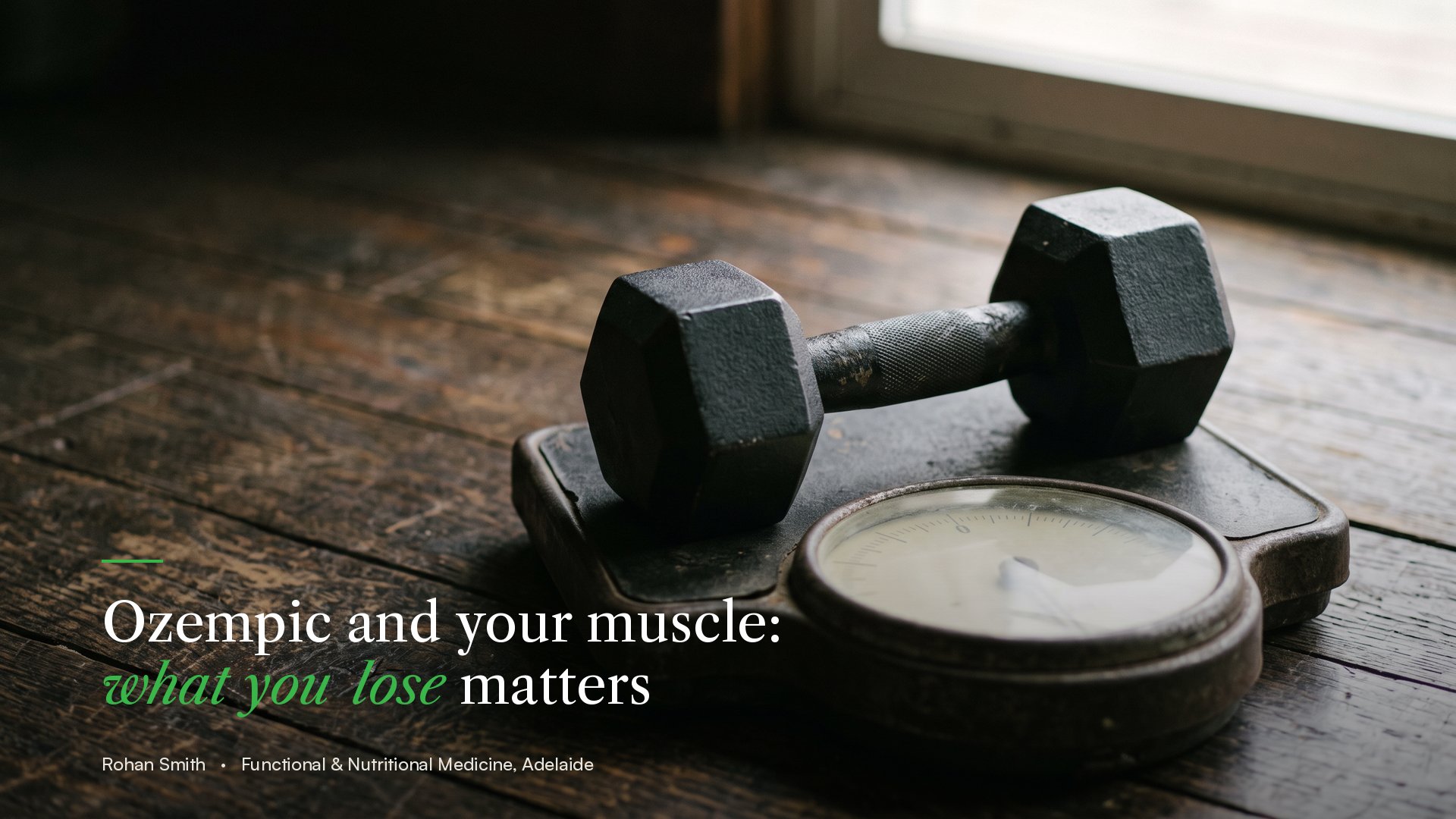
Yes, Ozempic, Wegovy and Mounjaro can cause some muscle loss. These medicines help people lose a lot of weight, but not all of that weight is fat. Across the studies so far, a bit over a quarter of the weight people lose comes from muscle and other lean tissue.[3]
That sounds worse than it may be. Part of that “lean” loss is water and other tissue, not muscle. And the muscle that remains often seems to work just as well as before.[4]
Muscle still matters. It soaks up sugar after meals and keeps you strong and steady as you age. People who start with less muscle, such as older adults and women after menopause, have the most to lose.
The good news is that you can protect it. Check your strength before you start, find out why the weight came on in the first place, and look after your muscle with strength training and enough protein the whole way through.
Why I’m writing about this
Most weeks now, someone in clinic tells me they have started Ozempic, Wegovy or Mounjaro, or that they are thinking about it.
These medicines work. In the big trials, people lost about 15 to 20% of their body weight on average.[1][2] That is more than most people ever manage with diet alone.
So the question I hear most has changed. People want to know what exactly they are losing. It’s a good question, and the answer is more hopeful than the scary headlines suggest.
How much of the weight is muscle?
Think of the weight you lose as one big bag. Most of what’s in the bag is fat, and that is the part you want gone. But some of it is muscle.
A large recent review looked at 35 studies of these medicines. On average, a bit over a quarter of the weight people lost came from muscle and other lean tissue.[3] The amount varied a lot from study to study, and from person to person.[4]
The same review found something people often miss. Losing weight through diet alone also takes some muscle with it.[3] It happens whenever the body gets smaller quickly, with or without an injection.
The scans also make the loss look bigger than it is. The body scans used in these studies measure “lean mass”. That lumps muscle together with water, organs and bone.[4] When you lose a lot of fat, some of that water goes too. So the real muscle loss is usually smaller than the scan makes it look.
Less muscle, but possibly better muscle
MRI scans can look at muscle directly. One recent study used MRI to follow people on semaglutide, the medicine in Ozempic and Wegovy.[5]
People lost a lot of fat, including the deep fat around their organs. Their thigh muscles shrank a little. But the fat marbled through those muscles went down, a bit like a leaner cut of steak. And they could still stand up from a chair just as easily as before.
Researchers think the body may be adapting. A smaller body needs less muscle to carry it around, and the muscle that stays may work a little better.[4] That study was small, and several of its authors work for the drug’s maker, so it needs confirming. Still, it is encouraging.
Muscle is your body’s sugar sponge
Muscle does far more than lift things. After you eat, insulin moves sugar out of your blood, and most of it is meant to go into your muscles. You can think of muscle as a sponge that soaks it up.
When muscle stops responding to insulin properly, that sponge stops working well. This is called insulin resistance, and diabetes researchers see it as the main underlying problem in type 2 diabetes.[6] Less muscle means a smaller sponge.
This is why I want to know why someone gained weight before they start one of these medicines. Insulin resistance often starts years before your blood sugar looks high. A fasting insulin test can pick it up early, and a simple score called HOMA-IR can be worked out from the same blood test.[7] If insulin resistance is behind the weight, keeping your muscle is part of fixing it.
Strength matters beyond blood sugar too. A large study across 17 countries found that people with a weaker grip were more likely to die early, including from heart disease.[8] A simple squeeze test tells us something the bathroom scale never will.
Who needs to be most careful
Losing a little muscle matters less if you have plenty to begin with. The people I watch most closely are those with less in the bank.
Doctors use the word sarcopenia for muscle that has become too weak and too small. The European definition now looks at strength first, then confirms it with a scan.[9] It is common in older age, but it can start earlier.
Some people carry extra body fat and too little muscle at the same time. Experts call this sarcopenic obesity, and they recommend checking strength first.[10] These people can look like ideal candidates for a weight-loss medicine, yet they are the ones who can least afford to lose muscle.
Women after menopause also start at a disadvantage. As oestrogen falls, the body tends to hold less muscle and more fat around the middle. A 2026 review suggests protein and strength exercise may help protect muscle in this group, though the research is still early.[11] If this is you, look at the hormone side of the picture alongside the weight.
What to check, and why it helps
Obesity and nutrition experts recommend checking strength and body make-up before starting one of these medicines.[12] These are the checks I find most useful.
| Check | What it tells you | Why it helps |
|---|---|---|
| Grip strength | How strong you are overall | Low strength is the main sign doctors look for |
| Standing up from a chair | How strong your legs are | Shows whether everyday tasks are getting harder |
| Body make-up scan | How much is fat and how much is lean | Means the scale isn’t your only measure |
| Fasting insulin | Early insulin resistance | Helps explain why the weight came on |
| Iron, B12, vitamin D | Whether you’re running low | Eating much less makes shortfalls more likely |
Check before you start, then again along the way. If the scale is dropping and your grip is getting weaker too, that is the time to act.
Protecting muscle while the scale drops
Experts now say looking after muscle should be a standard part of using these medicines.[12] It is also the part most people skip, because the weight seems to come off on its own.
Two habits make the biggest difference.
The first is strength training. When you work a muscle against resistance, you send your body a clear message: keep this. A Melbourne review found that adding exercise while cutting back on food helped people keep more lean tissue and get stronger.[13] Weights, resistance bands and bodyweight exercises all count. What matters is doing it regularly and slowly making it harder.
The second is protein. Your muscles are built from it. In studies of adults over 50, those who ate more protein while losing weight kept more of their muscle.[14] Here in Adelaide, University of South Australia researchers found the benefit lasted best in people who stuck with it.[15]
On these medicines, you fill up fast. So eat your protein first at each meal, before the rest of the plate. How much you need depends on your size, age and health, so I work it out with each person. My article on muscle and ageing explains why strength matters more than the number on the scale.
What happens when you stop
Most people regain weight after they stop.[16] In one study, people got back about two-thirds of the weight they had lost within a year of coming off the medicine.[17]
That is a reason to use your time on these medicines well. The muscle you build, and the eating and exercise habits you form, stay with you after the prescription ends. I wrote about the gut and hormone side of these medicines in an earlier article on weight-loss drugs.
How I approach it in clinic
For many people these medicines are a useful tool, and whether to use one is a decision for you and your GP. My job is to help it work as well as it can.
That means looking for what drove the weight gain in the first place, such as insulin resistance, thyroid, low iron, poor sleep or stress. It means checking your strength at the start so we can tell fat loss from muscle loss later. And it means building the protein and training habits that protect you while you’re on the medicine and after you stop. Our functional testing and thyroid and metabolism pages explain the tests we use.
Key Insights
Frequently asked questions
Does Ozempic cause muscle loss?
It can. As with any large weight loss, some of what you lose on Ozempic or Wegovy is muscle and other lean tissue rather than fat. Across the studies so far, that has been a bit over a quarter of the weight lost. The muscle that remains often has less fat through it and seems to work well. Strength training and enough protein help you keep what you have.
How much of the weight lost on Mounjaro or Ozempic is muscle?
It varies a lot between people. On average, a bit over a quarter of the weight lost comes from lean tissue. But scans count water, organs and bone as lean tissue too, so the true muscle loss is usually smaller than the numbers suggest. Older adults and women after menopause tend to have the least muscle to spare, so they need to be the most careful.
How can I keep muscle while taking a GLP-1 medicine?
Two habits help most. The first is regular strength training that slowly gets harder, using weights, bands or your own bodyweight. The second is eating enough protein at every meal. Because these medicines make you feel full quickly, eat your protein first, before the rest of the plate. How much protein you need depends on your size, age and health, so it is best worked out individually.
Should I get tested before starting Ozempic or Mounjaro?
A starting point helps. A grip test, a chair-stand test and a body make-up scan let you tell fat loss from muscle loss later on. Blood tests such as fasting insulin, thyroid, iron, B12 and vitamin D help explain why the weight came on and catch shortfalls that can get worse as you eat less. Whether to start the medicine is a decision for you and your GP, and testing helps it work as well as it can.
Ready to find answers?
If you are on one of these medicines or thinking about it, we can check your starting point, look at why the weight came on, and build a plan that protects your muscle.
References
- Wilding JPH, Batterham RL, Calanna S, et al. Once-Weekly Semaglutide in Adults with Overweight or Obesity. N Engl J Med. 2021;384(11):989-1002. doi:10.1056/NEJMoa2032183
- Jastreboff AM, Aronne LJ, Ahmad NN, et al. Tirzepatide Once Weekly for the Treatment of Obesity. N Engl J Med. 2022;387(3):205-216. doi:10.1056/NEJMoa2206038
- Batsis JA, Gavras A, Gross DC, et al. Effect of Incretin-Based and Nonpharmacologic Weight Loss on Body Composition: A Systematic Review. Ann Intern Med. 2026;179(7):996-1013. doi:10.7326/ANNALS-25-00478
- Neeland IJ, Linge J, Birkenfeld AL. Changes in lean body mass with glucagon-like peptide-1-based therapies and mitigation strategies. Diabetes Obes Metab. 2024;26 Suppl 4:16-27. doi:10.1111/dom.15728
- Hjelmesæth J, Bhat S, Garvey WT, et al. Effect of Semaglutide on Thigh Skeletal Muscle Volume, Fat Infiltration and Physical Function in People With Obesity: Secondary Analysis of STEP UP. Diabetes Obes Metab. 2026;28(12):11653-11663. doi:10.1111/dom.71323
- DeFronzo RA, Tripathy D. Skeletal muscle insulin resistance is the primary defect in type 2 diabetes. Diabetes Care. 2009;32 Suppl 2:S157-63. doi:10.2337/dc09-S302
- Matthews DR, Hosker JP, Rudenski AS, et al. Homeostasis model assessment: insulin resistance and beta-cell function from fasting plasma glucose and insulin concentrations in man. Diabetologia. 1985;28(7):412-9. doi:10.1007/BF00280883
- Leong DP, Teo KK, Rangarajan S, et al. Prognostic value of grip strength: findings from the Prospective Urban Rural Epidemiology (PURE) study. Lancet. 2015;386(9990):266-73. doi:10.1016/S0140-6736(14)62000-6
- Cruz-Jentoft AJ, Bahat G, Bauer J, et al. Sarcopenia: revised European consensus on definition and diagnosis. Age Ageing. 2019;48(1):16-31. doi:10.1093/ageing/afy169
- Donini LM, Busetto L, Bischoff SC, et al. Definition and diagnostic criteria for sarcopenic obesity: ESPEN and EASO consensus statement. Clin Nutr. 2022;41(4):990-1000. doi:10.1016/j.clnu.2021.11.014
- Pereira NRM, Ishikura IA, Tufik S, Hachul H. Semaglutide in postmenopausal women: Clinical implications for weight loss, muscle health, and sleep-disordered breathing. Maturitas. 2026;214:109129. doi:10.1016/j.maturitas.2026.109129
- Mozaffarian D, Agarwal M, Aggarwal M, et al. Nutritional priorities to support GLP-1 therapy for obesity: a joint Advisory from the American College of Lifestyle Medicine, the American Society for Nutrition, the Obesity Medicine Association, and The Obesity Society. Am J Clin Nutr. 2025;122(1):344-367. doi:10.1016/j.ajcnut.2025.04.023
- Miller CT, Fraser SF, Levinger I, et al. The effects of exercise training in addition to energy restriction on functional capacities and body composition in obese adults during weight loss: a systematic review. PLoS One. 2013;8(11):e81692. doi:10.1371/journal.pone.0081692
- Kim JE, O'Connor LE, Sands LP, et al. Effects of dietary protein intake on body composition changes after weight loss in older adults: a systematic review and meta-analysis. Nutr Rev. 2016;74(3):210-24. doi:10.1093/nutrit/nuv065
- Clifton PM, Condo D, Keogh JB. Long term weight maintenance after advice to consume low carbohydrate, higher protein diets: a systematic review and meta analysis. Nutr Metab Cardiovasc Dis. 2014;24(3):224-35. doi:10.1016/j.numecd.2013.11.006
- Rubino D, Abrahamsson N, Davies M, et al. Effect of Continued Weekly Subcutaneous Semaglutide vs Placebo on Weight Loss Maintenance in Adults With Overweight or Obesity: The STEP 4 Randomized Clinical Trial. JAMA. 2021;325(14):1414-1425. doi:10.1001/jama.2021.3224
- Wilding JPH, Batterham RL, Davies M, et al. Weight regain and cardiometabolic effects after withdrawal of semaglutide: The STEP 1 trial extension. Diabetes Obes Metab. 2022;24(8):1553-1564. doi:10.1111/dom.14725