Calming your nervous system shouldn’t feel like a second job
Calming your nervous system shouldn’t feel like a second job
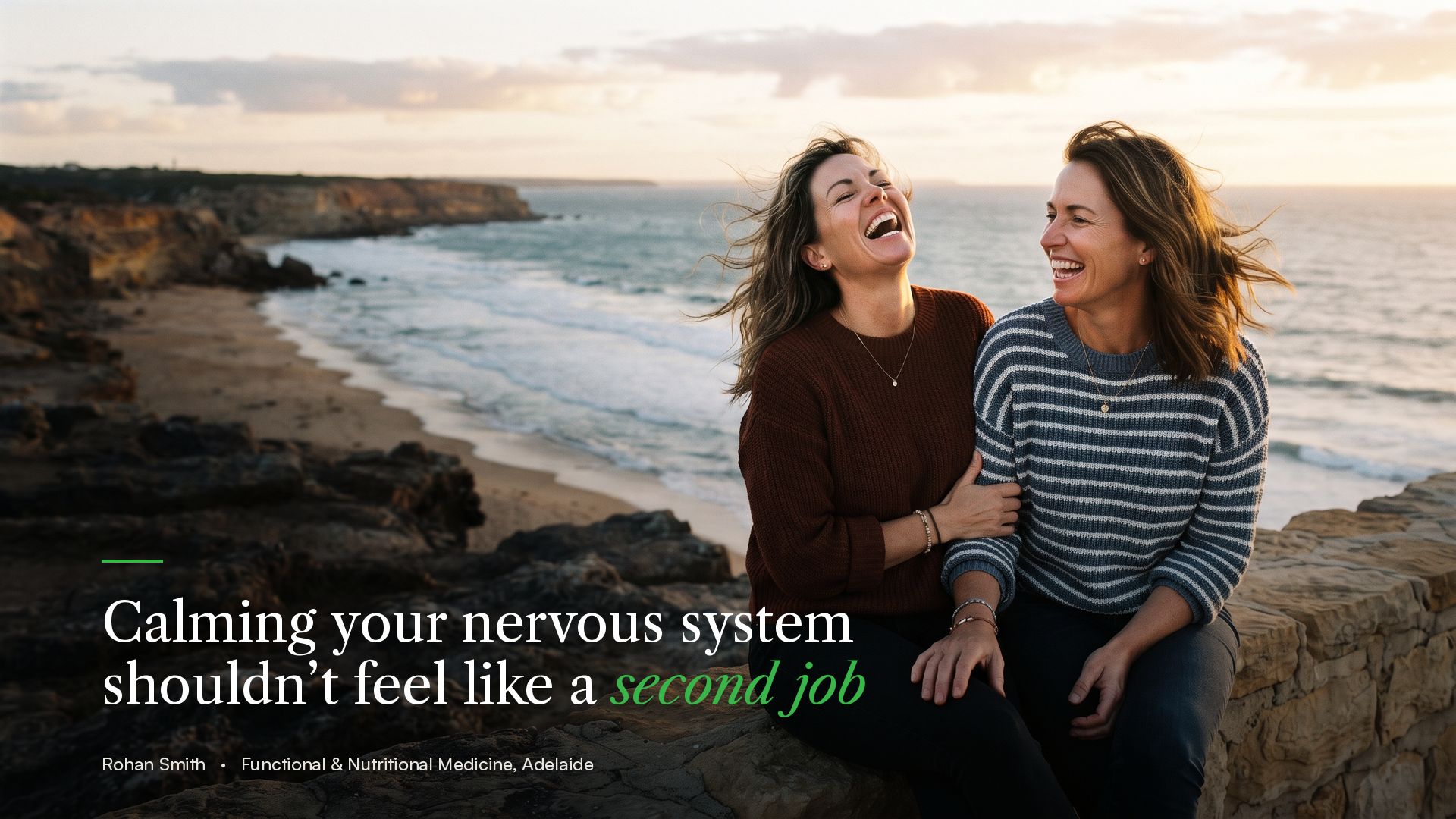
When people talk about calming the nervous system, or a nervous system reset, they usually mean moving the body out of a stress state. You can do that with more than breathwork, cold plunges and a long supplement routine. Laughing with friends, playing, spending time outdoors, feeling awe and staying close to people have all been linked with lower stress markers or better health.
Laughter has the most direct data. In a 2023 meta-analysis of eight small studies, cortisol, the body’s main stress hormone, fell about 32% more after laughter than in control conditions.[1] In a study of 36 city dwellers, a visit to somewhere that felt like nature lowered salivary cortisol, and 20 to 30 minutes gave the best return for the time spent.[2]
There are limits. Most of these studies are small or observational, so they can’t prove that enjoyment heals anything, and some popular claims go further than the data. Laughter won’t correct low iron or an underactive thyroid, and feeling unable to enjoy anything can be a symptom that needs care in its own right.
In clinic I try to look after both sides. We look for the physical driver, and we make sure the plan still leaves room for a life. A plan you can’t keep up won’t help you for long, however good it looks on paper.
When looking after your health becomes a workload
Many people I see are working hard at getting well. They have a morning routine, a list of foods to avoid, a shelf of supplements and a few apps. Many of those tools are useful, and I use targeted testing and supplements every day. The trouble starts when the plan keeps growing and nothing ever comes off it.
Researchers call this treatment burden: the work people take on to manage their health. It has been linked with poorer outcomes, and a review of stroke care found that demanding care made sticking to a plan less likely.[6][7] This research comes from serious chronic illness, so applying it to a self-directed health routine is my own extension.
Stress physiology is the other reason to care. Cortisol and adrenaline protect you in the short term, but keeping them running without enough recovery adds up to a cumulative cost known as allostatic load.[3]
Positive experiences appear to show up in the same biology. In one study of middle-aged adults, happier people had lower cortisol output across the day and a lower heart rate.[4] Across 1,399 people, those who took part in more enjoyable leisure activities had lower blood pressure, cortisol and waist measurements.[5] These are associations, and people who feel well also find it easier to go out and have fun.
What laughter actually changes
A 2023 meta-analysis pooled eight studies and 315 adults, most of whom watched comedy or attended laughter sessions. Cortisol fell about 32% more than in control conditions. The four randomised trials showed a fall of about 37%, and a single session was enough to see an effect.[1]
In a crossover study of 17 healthy adults, blood vessel function improved 17% after 30 minutes of comedy and fell 15% after a documentary, although artery flexibility was back to baseline within 24 hours.[8] Brain scans in 12 men showed the body’s own opioids being released after watching comedy with close friends.[9] Pain tolerance also rises after laughing.[10]
You may have seen claims that laughter restores what supplements can’t, or that play calms the body just as well as breathwork. I’m not aware of any trial that has tested either claim head to head. Laughter can take the edge off stress. A nutrient deficiency still needs its own fix.
Play and hobbies aren’t only for children
In a randomised, placebo-controlled trial of 533 people, one week of simple exercises, such as “three playful things”, increased playfulness, lifted wellbeing in the short term and eased depressive symptoms.[11]
Cortisol also fell in 39 healthy adults after 45 minutes of art making, though that study had no comparison group.[12] Across 93,263 people aged 65 and over in 16 countries, having a hobby was linked with fewer depressive symptoms and better self-reported health, happiness and life satisfaction.[13]
Trackers and tests have their place, and plenty of what I do relies on good data. Keep a few things in your week that have no target attached, the kind of thing you’d do even if nobody measured it.
Rest counts, and so does switching off
A meta-analysis covering 38,124 employees looked at psychological detachment, which means mentally switching off from work outside work hours. People who detached more reported less exhaustion, better sleep and greater wellbeing, although the link with physiological stress markers wasn’t significant. Doing work tasks in your time off went with less detachment.[14]
Time off may not help much if your head never leaves the office, a pattern I often see in chronic fatigue and burnout. Our page on hormones and stress explains how we assess the physical side.
Awe, nature and the people around you
Awe is the feeling of being in the presence of something vast. In two studies it was the positive emotion most strongly linked with lower IL-6, an inflammatory marker, although the design can’t show cause.[15] In a trial of 60 older adults, weekly 15-minute walks that encouraged awe brought more joy and less daily distress over eight weeks, while anxiety and depression scores didn’t change.[16] Researchers have proposed several pathways for this, including shifts in physiology and less self-focus.[17]
A survey of 19,806 people in England found the link with good health and wellbeing began at about 120 minutes a week and levelled off between 200 and 300 minutes, however the time was split up.[18] A Brisbane study estimated that visiting green space for 30 minutes or more during a week could lower population rates of depression by up to 7% and high blood pressure by up to 9%.[19]
Relationships have some of the strongest long-term data. Across 148 studies and more than 300,000 people, stronger social relationships were linked with 50% better odds of survival.[20] A later analysis of 90 cohort studies linked social isolation with a 32% higher risk of death from any cause, and loneliness with a 14% higher risk.[21] When 404 healthy adults were exposed to a cold virus, more social support and more frequent hugs went with better protection against the effects of conflict, and milder symptoms in those who became infected.[22] In an earlier cold-virus study, people with the lowest tendency toward positive emotions were about three times as likely to develop a cold as those with the highest.[23]
How strong is the evidence?
What the research can and can’t tell us.
| Activity | What was found | How sure we can be |
|---|---|---|
| Laughter | Lower cortisol than control conditions; short-term vascular changes.[1][8] | Moderate for short-term cortisol. No long-term outcomes. |
| Play and hobbies | Short-term wellbeing gains in a large trial; fewer depressive symptoms with hobbies in later life.[11][13] | Moderate for mood. Limited for physical health. |
| Switching off | Less exhaustion and better sleep; no significant link with physiological stress markers.[14] | Moderate for how people feel. Mostly self-report. |
| Time in nature | Lower salivary cortisol after visits; better self-rated health from about two hours a week.[2][18] | Moderate. Large surveys plus small studies. |
| Awe | More joy and less daily distress in one trial; lower IL-6 in observational work.[15][16] | Early. Few trials, small samples. |
| Connection | Better survival with stronger relationships; higher mortality with isolation.[20][21] | Strong association. Can’t prove cause. |
These findings support making room for enjoyment. They don’t support using it in place of investigation or medical care.
When joy is not enough
Telling someone who is exhausted to laugh more can be unkind, and it can miss the cause. Low iron, low B12, thyroid problems, sleep apnoea, blood sugar swings and post-viral illness can all drain your energy and mood. Standard blood tests can help sort out many of these. If stress itself is the question, a DUTCH adrenal test maps your cortisol pattern through the day.
Losing interest in things you used to enjoy deserves particular attention. It can be a symptom of depression, not a lack of effort, and scheduled fun won’t fix it on its own. Please speak to your GP. If brain fog or low mood has become your normal, it’s also worth checking for physical contributors.
If you’re otherwise on the right track, ask which parts of your plan are clearly helping and whether anything could safely come off. Don’t stop prescribed medication without talking to your prescriber. Then add one small thing this week that you’d enjoy anyway: a walk with a friend, a funny film, an hour in the garden.
Key Insights
Frequently asked questions
How can I calm my nervous system?
Slow breathing is one option. Research also links laughter, play, time outdoors, moments of awe, close relationships and switching off from work with lower stress markers or better wellbeing. Choose something you enjoy and can keep doing. If you still feel wired or exhausted after a few weeks, look for a physical driver such as poor sleep, low iron or a thyroid problem.
Does laughter really lower cortisol?
The evidence suggests it does, at least in the short term. A 2023 meta-analysis of eight studies found cortisol fell about 32% more after laughter than in control conditions, and the four randomised trials showed a similar result. The studies were small, with 315 people in total, and they don’t show whether regular laughter changes long-term health. It isn’t a treatment for a medical condition.
How much time in nature do you need to feel a benefit?
A survey of nearly 20,000 people in England found the link with good health and wellbeing appeared at about 120 minutes a week and levelled off at around 200 to 300 minutes. One long visit or several short ones made no difference. In a smaller study, 20 to 30 minutes gave the best cortisol return for the time spent. These figures are a guide.
Why do I still feel exhausted after resting?
Rest helps most when tiredness comes from load. If you sleep well, take time off and still feel exhausted, something else may be involved. Low iron, low B12, thyroid problems, sleep apnoea, blood sugar swings, depression and post-viral illness can all look like burnout. These need assessment, not more willpower. Your GP is a good place to start, and a functional medicine consultation can look at the wider pattern.
Ready to find answers?
If you’ve been doing everything right and still don’t feel like yourself, let’s work out why and build a plan you can live with.
References
- Kramer CK, Leitao CB. Laughter as medicine: a systematic review and meta-analysis of interventional studies evaluating the impact of spontaneous laughter on cortisol levels. PLoS One. 2023;18(5):e0286260. doi:10.1371/journal.pone.0286260
- Hunter MR, Gillespie BW, Chen SY. Urban nature experiences reduce stress in the context of daily life based on salivary biomarkers. Front Psychol. 2019;10:722. doi:10.3389/fpsyg.2019.00722
- McEwen BS. Protective and damaging effects of stress mediators. N Engl J Med. 1998;338(3):171-179. doi:10.1056/NEJM199801153380307
- Steptoe A, Wardle J, Marmot M. Positive affect and health-related neuroendocrine, cardiovascular, and inflammatory processes. Proc Natl Acad Sci U S A. 2005;102(18):6508-6512. doi:10.1073/pnas.0409174102
- Pressman SD, Matthews KA, Cohen S, et al. Association of enjoyable leisure activities with psychological and physical well-being. Psychosom Med. 2009;71(7):725-732. doi:10.1097/PSY.0b013e3181ad7978
- Boehmer KR, Abu Dabrh AM, Gionfriddo MR, et al. Does the chronic care model meet the emerging needs of people living with multimorbidity? A systematic review and thematic synthesis. PLoS One. 2018;13(2):e0190852. doi:10.1371/journal.pone.0190852
- Gallacher K, Morrison D, Jani B, et al. Uncovering treatment burden as a key concept for stroke care: a systematic review of qualitative research. PLoS Med. 2013;10(6):e1001473. doi:10.1371/journal.pmed.1001473
- Sugawara J, Tarumi T, Tanaka H. Effect of mirthful laughter on vascular function. Am J Cardiol. 2010;106(6):856-859. doi:10.1016/j.amjcard.2010.05.011
- Manninen S, Tuominen L, Dunbar RI, et al. Social laughter triggers endogenous opioid release in humans. J Neurosci. 2017;37(25):6125-6131. doi:10.1523/JNEUROSCI.0688-16.2017
- Dunbar RIM, Baron R, Frangou A, et al. Social laughter is correlated with an elevated pain threshold. Proc Biol Sci. 2012;279(1731):1161-1167. doi:10.1098/rspb.2011.1373
- Proyer RT, Gander F, Brauer K, Chick G. Can playfulness be stimulated? A randomised placebo-controlled online playfulness intervention study on effects on trait playfulness, well-being, and depression. Appl Psychol Health Well Being. 2021;13(1):129-151. doi:10.1111/aphw.12220
- Kaimal G, Ray K, Muniz J. Reduction of cortisol levels and participants’ responses following art making. Art Ther. 2016;33(2):74-80. doi:10.1080/07421656.2016.1166832
- Mak HW, Noguchi T, Bone JK, et al. Hobby engagement and mental wellbeing among people aged 65 years and older in 16 countries. Nat Med. 2023;29(9):2233-2240. doi:10.1038/s41591-023-02506-1
- Wendsche J, Lohmann-Haislah A. A meta-analysis on antecedents and outcomes of detachment from work. Front Psychol. 2017;7:2072. doi:10.3389/fpsyg.2016.02072
- Stellar JE, John-Henderson N, Anderson CL, et al. Positive affect and markers of inflammation: discrete positive emotions predict lower levels of inflammatory cytokines. Emotion. 2015;15(2):129-133. doi:10.1037/emo0000033
- Sturm VE, Datta S, Roy ARK, et al. Big smile, small self: awe walks promote prosocial positive emotions in older adults. Emotion. 2022;22(5):1044-1058. doi:10.1037/emo0000876
- Monroy M, Keltner D. Awe as a pathway to mental and physical health. Perspect Psychol Sci. 2023;18(2):309-320. doi:10.1177/17456916221094856
- White MP, Alcock I, Grellier J, et al. Spending at least 120 minutes a week in nature is associated with good health and wellbeing. Sci Rep. 2019;9(1):7730. doi:10.1038/s41598-019-44097-3
- Shanahan DF, Bush R, Gaston KJ, et al. Health benefits from nature experiences depend on dose. Sci Rep. 2016;6:28551. doi:10.1038/srep28551
- Holt-Lunstad J, Smith TB, Layton JB. Social relationships and mortality risk: a meta-analytic review. PLoS Med. 2010;7(7):e1000316. doi:10.1371/journal.pmed.1000316
- Wang F, Gao Y, Han Z, et al. A systematic review and meta-analysis of 90 cohort studies of social isolation, loneliness and mortality. Nat Hum Behav. 2023;7(8):1307-1319. doi:10.1038/s41562-023-01617-6
- Cohen S, Janicki-Deverts D, Turner RB, Doyle WJ. Does hugging provide stress-buffering social support? A study of susceptibility to upper respiratory infection and illness. Psychol Sci. 2015;26(2):135-147. doi:10.1177/0956797614559284
- Cohen S, Doyle WJ, Turner RB, Alper CM, Skoner DP. Emotional style and susceptibility to the common cold. Psychosom Med. 2003;65(4):652-657. doi:10.1097/01.psy.0000077508.57784.da