
Low Stomach Acid: When the Problem Is Too Little, Not Too Much
Low stomach acid: when the problem is too little, not too much
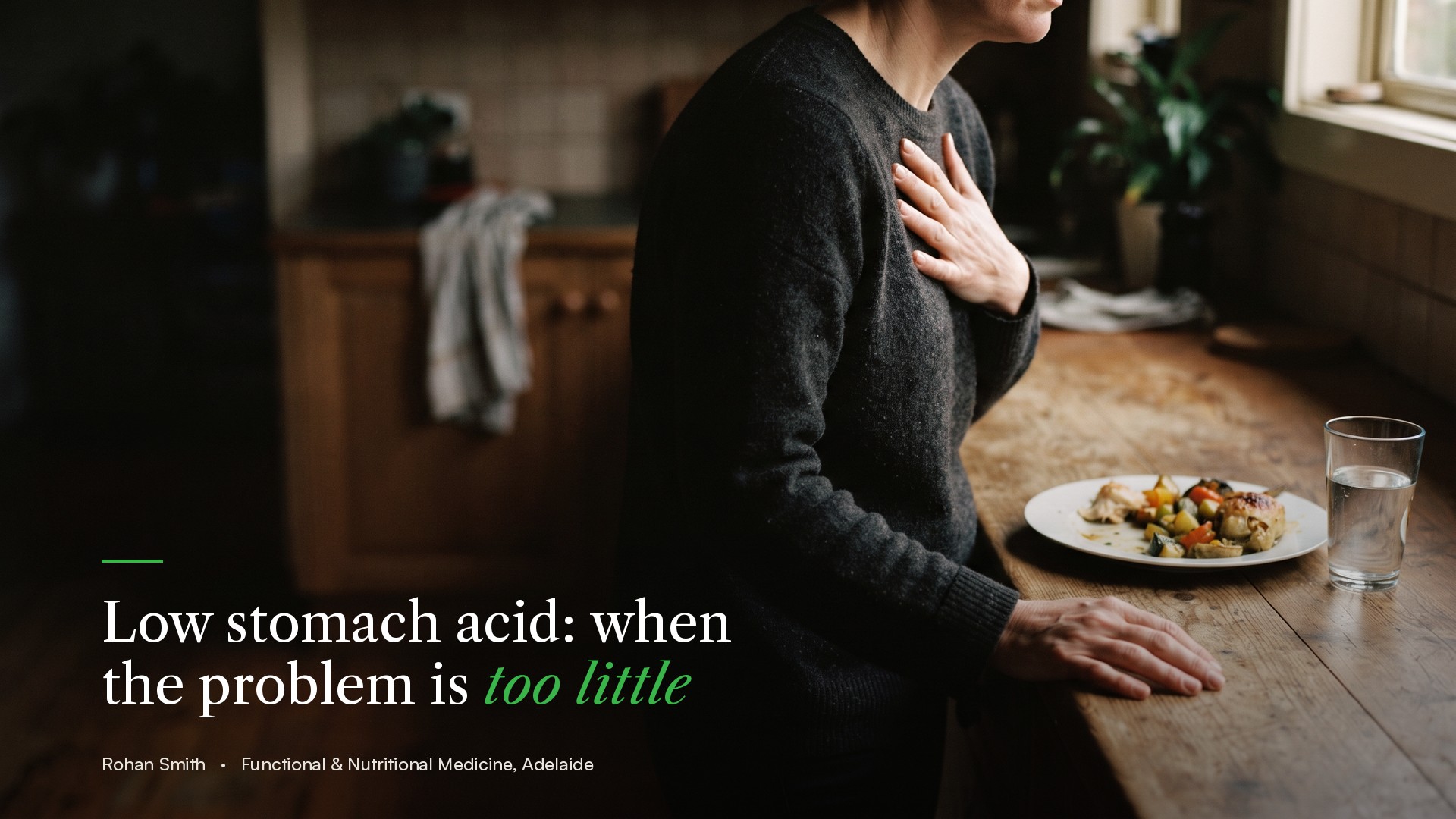
Low stomach acid, known clinically as hypochlorhydria, means the stomach isn’t making enough hydrochloric acid to do its job properly. It is a real, measurable condition, and it is more common than most people expect – particularly with age, after a Helicobacter pylori infection, in autoimmune gastritis, after years on acid-suppressing medication, and under sustained stress.
It often goes unrecognised because its symptoms overlap so closely with classic reflux: fullness, bloating, burping, and a burning sensation can all show up whether acid is too high or too low, so the instinct is to suppress it further without checking which problem is actually there.
Stomach acid does more than break down food. It acts as a barrier that inactivates much of what you swallow, it switches on the enzymes that digest protein, and it helps free minerals for absorption further down. When acid falls, bacteria that would normally be killed can survive deeper into the gut, and nutrients such as vitamin B12, iron, magnesium, and calcium become harder to absorb.
The point is not that all reflux is caused by low acid. Reflux is usually about acid reaching the wrong place. It is that low acid is a distinct, testable pattern worth ruling out before committing to years of acid suppression, because the right answer changes the plan.
What your stomach acid is actually doing
It is easy to treat stomach acid as pure irritant, but that misses how much it does. A healthy stomach is strongly acidic, and that acidity is what the rest of digestion depends on. It switches pepsin, the main protein-digesting enzyme, into its working form, and it loosens minerals from food so iron, calcium, and magnesium can be absorbed downstream. It also acts as a gatekeeper, inactivating much of what you swallow before it reaches the small intestine.[1]
When heartburn isn’t a too-much-acid problem
Reflux is one of the most common reasons people reach for medication, and the standard story is simple: too much acid, so reduce it. For many people that’s broadly right, and reflux is really about acid ending up where it shouldn’t, not how much is made. But low acid can look almost identical from the outside – heaviness after meals, bloating, belching, and burning all appear when acid is low, because food sits and ferments rather than moving through.
This is where the popular version overshoots: online you’ll often see the claim that reflux is essentially always low acid in disguise. That goes further than the evidence supports, and it’s risky if it leads someone to quietly stop effective medication. The honest position sits in between – low stomach acid is a real, under-tested pattern that overlaps with reflux, so it deserves to be checked rather than assumed either way.
Where stress comes into it
There’s a thread running under a lot of this, and it’s the one I see most in clinic. Digestion runs on the “rest and digest” side of the nervous system, and a good part of your acid output is driven by the vagus nerve as you anticipate and eat a meal. When you’re wired, rushed, or eating on the run, that vagal drive drops and gastric secretion shifts with it, so a chronically stressed body can simply make less acid when it counts.[17][18]
Stress works on the other end too. It relaxes the lower oesophageal sphincter, the valve between the stomach and the oesophagus, so even a modest amount of acid can wash back up and burn, and it sharpens how intensely that burning is felt.[19][20] That’s the bind: less acid below, a looser valve above, and a nervous system primed to feel every twinge – which is why “just take something for the acid” so often sidesteps what’s actually driving it.
What actually lowers stomach acid
Acid output isn’t fixed for life, and several things push it down, often more than one at once: ageing and atrophic gastritis, which slowly lose the acid-producing cells;[4][15] H. pylori, which turns the acid pumps down and can smoulder for years;[3] long-term proton pump inhibitors and H2 blockers, effective by design but capable of leaving acid very low over months to years;[8][9] and, less commonly, autoimmune gastritis, where the immune system attacks both the acid-producing cells and the intrinsic factor needed for B12.[5][6]
Why stomach acid drops
Four of the most common reasons acid output falls, and the clues that make each one worth checking.
| Driver | What’s happening | When to suspect it |
|---|---|---|
| Ageing & atrophic gastritis | The acid-producing cells in the stomach lining thin out and are gradually lost, so acid output falls. | Older age, a long history of vague indigestion, or low B12 or iron with no obvious cause. |
| Helicobacter pylori | The infection switches down the stomach’s acid pumps and inflames the lining. | A past “stomach bug,” ulcer history, or a positive breath or stool test. |
| Acid-suppressing medication | PPIs and H2 blockers reduce acid by design; years of use can leave it very low. | On reflux medication for many months or years, with symptoms creeping back on stopping. |
| Autoimmune gastritis | The immune system attacks the acid-producing (parietal) cells and intrinsic factor. | Other autoimmune conditions, pernicious anaemia, or positive parietal-cell antibodies. |
| Chronic stress | A wired, sympathetic-dominant state lowers the vagal drive to acid and loosens the valve above the stomach. | Symptoms flare in busy or anxious stretches and ease when life settles. |
None of these can be confirmed from symptoms alone, and many people carry more than one at once. Telling them apart takes H. pylori testing, blood markers (gastrin, B12, iron, parietal-cell antibodies), and gastroscopy where indicated – see our functional testing page.
How low acid feeds bacterial overgrowth
Normally, strong acidity inactivates most of the bacteria arriving from the mouth and food, so the small intestine stays relatively sparse.[2] Lower the acid and that gate stops closing. A recent preliminary study of 31 patients found that those with low stomach acid, mostly people with atrophic gastritis, had greater bacterial diversity in the duodenum, including mouth-dwelling species not usually found there.[1] It’s early, small-scale work, but it fits a long-standing pattern.
That pattern is small intestinal bacterial overgrowth (SIBO): too many bacteria in a stretch of gut meant to stay clear. Low stomach acid, from atrophic gastritis or long-term acid suppression, is a recognised setup for it, and it brings on exactly the complaints people blame on reflux or a food intolerance: bloating, wind, changeable bowels, and discomfort after eating.[10][11][12] For more on this, see our page on gut health, IBS and SIBO.
The nutrient gaps low acid hides
The other quiet consequence is absorption. Several nutrients need an acidic stomach to be released and absorbed, so when acid stays low, gaps build before anything shows on a routine blood test. In chronic atrophic gastritis, deficiencies of B12, iron, vitamin C, folate, and calcium are all well described, and the same appears with long-term acid suppression.[7][8] B12 is the most classic, because absorbing it depends on both acid and intrinsic factor, which is why guidance flags long-term acid-suppressant use and older age as risk factors.[14]
Iron and magnesium follow the same logic, and low magnesium has been reported with prolonged acid suppression.[9][13] The catch is that these deficiencies rarely announce themselves. Fatigue, low mood, poor concentration, or hair thinning can all trace back to a nutrient the gut quietly stopped absorbing, which is why unexplained low B12 or iron is often the first hint that acid is involved. This overlaps with our chronic fatigue and burnout and complex chronic patterns pages.
Testing, not guessing
Because low-acid and high-acid problems feel so similar, everything turns on getting an actual answer rather than treating a hunch. That usually means checking H. pylori status, the blood markers that hint at low acid and its fallout (gastrin, B12, iron studies, antibodies), and, where warranted, gastroscopy or a direct measure of stomach pH. The aim is to separate the person who needs acid suppressed from the person who needs the opposite.
Two cautions matter here. First, at-home “acid tests” like the baking-soda burp or apple cider vinegar can’t measure your stomach acid and can point you the wrong way. Second, if you’re on reflux medication, this is not a cue to stop it: stopping abruptly can cause a rebound surge in acid, and if reflux is causing genuine damage you need that protection.[8] Any change belongs with the person who prescribed it. Where low acid is confirmed, there are ways to support digestion while the driver is addressed – a small trial found betaine hydrochloride could briefly restore stomach acidity in people whose acid had been suppressed, but that’s a research finding, not a self-prescription, and needs to be guided by testing.[16]
Key Insights
Frequently asked questions
Isn’t heartburn always caused by too much acid?
No. Classic reflux is usually about acid reaching the wrong place rather than sheer volume, and for many people reducing acid genuinely helps. But low stomach acid produces overlapping symptoms, including burning, fullness, and bloating, because food sits and ferments rather than moving through. The two feel similar from the outside, so the only reliable way to tell them apart is proper assessment rather than assuming it must be one or the other.
How do I know if I have low stomach acid?
You can’t tell from symptoms alone, because they mirror high-acid reflux so closely. A proper assessment looks at H. pylori status, blood markers such as gastrin, B12, iron studies, and parietal-cell antibodies, and, where the picture warrants it, gastroscopy or a direct measure of stomach pH. Unexplained low B12 or iron, or symptoms that persist despite acid-suppressing medication, are common clues that low acid is worth investigating.
Do the baking soda or apple cider vinegar tests actually work?
They’re popular online, but neither is a reliable measure of stomach acid. The baking-soda burp test times how long it takes to belch, which is affected by too many other things to mean much, and apple cider vinegar can’t diagnose anything or replace finding the cause. They can also mislead someone into self-treating the wrong problem. If low acid is a real question for you, it’s worth checking properly rather than relying on a kitchen experiment.
Should I stop my reflux medication if I think my acid is low?
Not on your own. Stopping acid-suppressing medication abruptly can trigger a rebound surge in acid that makes symptoms worse, and if your reflux is causing genuine irritation or damage you may need that protection. If you suspect low acid is part of your picture, the right step is to have it assessed and to work with whoever prescribed the medication on any change, rather than stopping suddenly.
Can low stomach acid cause bloating?
It can be one contributor. Low acid slows the breakdown of food and can allow bacteria to colonise further down the gut, both of which promote gas and bloating. That said, bloating has many possible drivers, from food sensitivities and constipation to genuine bacterial overgrowth, so it’s worth mapping the pattern rather than assuming acid is the cause. Identifying which mechanism is at work is what makes any plan actually fit.
Ready to find answers?
If reflux, bloating, or unexplained deficiencies keep circling back, it may be worth checking whether low stomach acid is part of the story, rather than guessing from symptoms.
References
- Filardo S, Scalese G, Virili C, et al. The Potential Role of Hypochlorhydria in the Development of Duodenal Dysbiosis: A Preliminary Report. Front Cell Infect Microbiol. 2022;12:854904. doi:10.3389/fcimb.2022.854904
- Husebye E. The pathogenesis of gastrointestinal bacterial overgrowth. Chemotherapy. 2005;51(Suppl 1):1–22. doi:10.1159/000081988
- Smolka AJ, Backert S. How Helicobacter pylori infection controls gastric acid secretion. J Gastroenterol. 2012;47(6):609–618. doi:10.1007/s00535-012-0592-1
- Li Y, Xia R, Zhang B, Li C. Chronic Atrophic Gastritis: A Review. J Environ Pathol Toxicol Oncol. 2018;37(3):241–259. doi:10.1615/JEnvironPatholToxicolOncol.2018026839
- Rustgi SD, Bijlani P, Shah SC. Autoimmune gastritis, with or without pernicious anemia: epidemiology, risk factors, and clinical management. Therap Adv Gastroenterol. 2021;14:17562848211038771. doi:10.1177/17562848211038771
- Conti L, Annibale B, Lahner E. Autoimmune Gastritis and Gastric Microbiota. Microorganisms. 2020;8(11):1827. doi:10.3390/microorganisms8111827
- Cavalcoli F, Zilli A, Conte D, Massironi S. Micronutrient deficiencies in patients with chronic atrophic autoimmune gastritis: A review. World J Gastroenterol. 2017;23(4):563–572. doi:10.3748/wjg.v23.i4.563
- Jensen RT. Consequences of long-term proton pump blockade: insights from studies of patients with gastrinomas. Basic Clin Pharmacol Toxicol. 2006;98(1):4–19. doi:10.1111/j.1742-7843.2006.pto_378.x
- Koyyada A. Long-term use of proton pump inhibitors as a risk factor for various adverse manifestations. Therapie. 2021;76(1):13–21. doi:10.1016/j.therap.2020.06.019
- Naito Y, Kashiwagi K, Takagi T, Andoh A, Inoue R. Intestinal Dysbiosis Secondary to Proton-Pump Inhibitor Use. Digestion. 2018;97(2):195–204. doi:10.1159/000481813
- Ghoshal UC, Shukla R, Ghoshal U. Small Intestinal Bacterial Overgrowth and Irritable Bowel Syndrome: A Bridge between Functional Organic Dichotomy. Gut Liver. 2017;11(2):196–208. doi:10.5009/gnl16126
- Rao SSC, Bhagatwala J. Small Intestinal Bacterial Overgrowth: Clinical Features and Therapeutic Management. Clin Transl Gastroenterol. 2019;10(10):e00078. doi:10.14309/ctg.0000000000000078
- de Baaij JHF, Hoenderop JGJ, Bindels RJM. Magnesium in man: implications for health and disease. Physiol Rev. 2015;95(1):1–46. doi:10.1152/physrev.00012.2014
- Langan RC, Goodbred AJ. Vitamin B12 Deficiency: Recognition and Management. Am Fam Physician. 2017;96(6):384–389. PMID:28925645
- Holt PR. Intestinal malabsorption in the elderly. Dig Dis. 2007;25(2):144–150. doi:10.1159/000099479
- Yago MR, Frymoyer AR, Smelick GS, et al. Gastric reacidification with betaine HCl in healthy volunteers with rabeprazole-induced hypochlorhydria. Mol Pharm. 2013;10(11):4032–4037. doi:10.1021/mp4003738
- Konturek PC, Brzozowski T, Konturek SJ. Stress and the gut: pathophysiology, clinical consequences, diagnostic approach and treatment options. J Physiol Pharmacol. 2011;62(6):591–599. PMID:22314561
- Taché Y, Adelson D, Yang H. TRH/TRH-R1 receptor signaling in the brain medulla as a pathway of vagally mediated gut responses during the cephalic phase. Curr Pharm Des. 2014;20(16):2725–2730. doi:10.2174/13816128113199990578
- Tack J, Pandolfino JE. Pathophysiology of Gastroesophageal Reflux Disease. Gastroenterology. 2018;154(2):277–288. doi:10.1053/j.gastro.2017.09.047
- Zheng J, Tao L. Multidimensional mechanisms and therapies underlying gastroesophageal reflux disease: focus on immunity, signaling pathways, and the microbiota-gut-brain axis. Front Immunol. 2025;16:1629944. doi:10.3389/fimmu.2025.1629944