
The sleep tax of new parenthood
The sleep tax of new parenthood

Fragmented sleep in parents of young children is a sustained physiological stressor with measurable consequences. It changes hormone output, depletes key nutrients, and shifts mood regulation in both partners at once.
In mothers, the picture often gets labelled postnatal depression. In fathers, it usually gets called work stress. Both are downstream of the same drivers: HPA axis dysregulation, depletion across iron, B12, folate, zinc, vitamin D and magnesium, disrupted thyroid function, and shifts in testosterone, oestradiol and progesterone that don’t correct on their own.
A Dutch Adrenal Test alongside a functional bloodwork panel maps the picture clinically and shows what standard postnatal care misses. The work is identifying what’s actually been drained, in whom, and to what degree. Willpower and a sleep schedule don’t fix this.
What broken sleep actually does to the body
Sleep loss in parents of young children isn’t the same physiology as short sleep in adults without dependents. The defining feature is fragmentation. The brain is woken repeatedly during the consolidating sleep phases, particularly slow-wave sleep and REM, both of which carry most of the restorative load.[1] Fragmented sleep produces metabolic and hormonal effects that are worse than short sleep of equivalent total duration.[2]
One week of sleep restriction reduces insulin sensitivity, raises evening cortisol, blunts the cortisol awakening response, and shifts the sympathetic nervous system into a higher baseline state of arousal.[3] Immune function drops measurably within 72 hours of disrupted sleep, including reduced natural killer cell activity and a rise in pro-inflammatory cytokines.[4] None of these effects requires extreme deprivation. They appear at the level of fragmentation most parents of infants are already running.
The mother’s cascade
Postnatal depletion describes the measurable nutrient and hormonal shortfall that follows pregnancy and breastfeeding when intake and recovery don’t catch up to the demand.[5] Iron stores fall during pregnancy and continue dropping during breastfeeding; ferritin under 30 is common, ferritin under 50 is functionally low for an active woman.[6] Active B12, folate, zinc, magnesium, vitamin D and omega-3 status all drop in parallel. Each carries downstream effects on energy, mood, thyroid conversion and cognitive function.
Postpartum thyroid changes are the most under-recognised piece. Postpartum thyroiditis affects five to ten percent of women in the first year postpartum, often presenting as anxiety and weight loss in the early phase before transitioning to fatigue, weight gain and low mood as the gland becomes underactive.[7] The pattern is routinely diagnosed as postnatal depression because TSH alone misses it. A full panel with fT3, fT4 and TPO antibodies catches it. See the thyroid and metabolism page for the broader thyroid workup template.
Sleep loss compounds all of this. Disrupted sleep raises evening cortisol, which suppresses progesterone synthesis through pregnenolone steal, worsens insulin sensitivity, and amplifies the amygdala’s reactivity to perceived threat.[8] Postpartum anxiety, intrusive thoughts, postnatal rage and the “wired but tired” state are predictable downstream consequences of this picture. The clinical mistake is treating mood symptoms as the primary diagnosis when the underlying picture is HPA dysregulation overlaid on nutrient debt.
Social isolation belongs in the clinical picture too. Reduced adult interaction, loss of professional identity, sensory overstimulation from constant physical contact, and the closing of social windows that previously regulated cortisol all feed back into the HPA loop.[9] The mother who reports feeling “touched out” isn’t describing a personality flaw. She’s describing a downregulation of the sensory-affective system under sustained allostatic load.
The father’s squeeze
Fathers of young children sleep, on average, 13 minutes less per night than mothers but recover more slowly because they are expected to maintain full work performance regardless.[10] Cognitive performance after four to five hours of fragmented sleep falls to levels equivalent to a blood alcohol concentration of 0.08 percent, the legally impaired threshold for driving.[1] Financial decisions, work strategy and relationship responses get made on those impaired faculties anyway.
Endocrine consequences in men are well documented. One week of sleep restriction to five hours per night reduces testosterone in healthy young men by 10 to 15 percent, a magnitude equivalent to 10 to 15 years of normal aging.[11] Chronic fragmented sleep at the levels typical of new fatherhood produces sustained suppression rather than a transient dip. Low testosterone in this context presents as low libido, low motivation, irritability, blunted reward response and slow recovery from physical effort. It is rarely tested for in men under 45 in standard primary care.
Paternal postnatal depression affects around one in ten Australian fathers and peaks at three to six months postpartum.[12] Its presentation is consistently different from maternal postnatal depression. Men more often present with irritability, withdrawal, increased alcohol use, somatic complaints, and a sense of being unable to provide. Sadness as a chief complaint is uncommon. Screening tools calibrated against the female presentation miss most of these cases.
The financial dimension layers on top. He’s carrying household income while running on insufficient sleep, holding the line with a depleted partner without permission to voice his own depletion, and absorbing the relationship strain that follows when both parents read each other through the lens of exhaustion. The allostatic load that builds from this is rarely captured by any single clinical metric.[13]
Standard postnatal screen vs. functional panel
The clinical picture parents of young children present with rarely shows up on a standard GP panel. A functional workup widens the lens.
| Marker | Standard GP postnatal check | Functional medicine panel |
|---|---|---|
| Iron | Haemoglobin only | Full iron studies plus ferritin, with functional range targets |
| B12 | Serum B12 if symptomatic | Active B12 (holotranscobalamin), homocysteine |
| Thyroid | TSH | TSH, fT3, fT4, TPO and thyroglobulin antibodies, reverse T3 |
| Cortisol | Not tested | Dutch Adrenal Test (diurnal cortisol/cortisone pattern, DHEA, melatonin metabolites) |
| Hormones | Not tested unless symptomatic | Oestradiol, progesterone, prolactin (mothers); total and free testosterone (fathers); SHBG |
| Metabolic | Fasting glucose, HbA1c if at risk | Fasting insulin, HOMA-IR, fasting glucose, HbA1c |
| Other nutrients | Vitamin D if requested | RBC magnesium, zinc, vitamin D, omega-3 index |
Each marker on the functional panel addresses a known driver of postnatal depletion symptoms. Standard panels were designed for screening, not for mapping recovery in physiologically depleted adults.
HPA axis dysregulation and nutrient debt
The thread connecting both partners’ symptom picture is allostatic load, the cumulative biological cost of repeated activation of the stress response system.[13] See the hormones and stress page for the clinical framework this sits inside. The HPA axis normally produces a high cortisol pulse on waking, a steep morning rise, a gentle daytime decline and a quiet evening trough. Sustained sleep fragmentation flattens this curve. Morning cortisol drops, evening cortisol stays elevated, and the body loses the diurnal signal that organises energy production, immune function and circadian alignment.[14]
The Dutch Adrenal Test catches this. Urinary cortisol and cortisone metabolites collected at four points across a single day map total daily cortisol production, the awakening response, and the breakdown pathways the body is using.[15] A single random serum cortisol cannot replicate that information.
Nutrient debt runs alongside. Pregnancy, breastfeeding, broken sleep and chronic stress all consume the same micronutrients: iron, B12, folate, zinc, magnesium, vitamin D, omega-3, and the B-complex group involved in methylation. Without targeted replenishment, the body cannot synthesise neurotransmitters efficiently, cannot convert thyroid hormone, cannot produce reproductive hormones in adequate quantities, and cannot recover mitochondrial output between cycles of demand.[16] Sleep restored without nutrient repletion still leaves a depleted body running on insufficient raw materials.
What to actually test
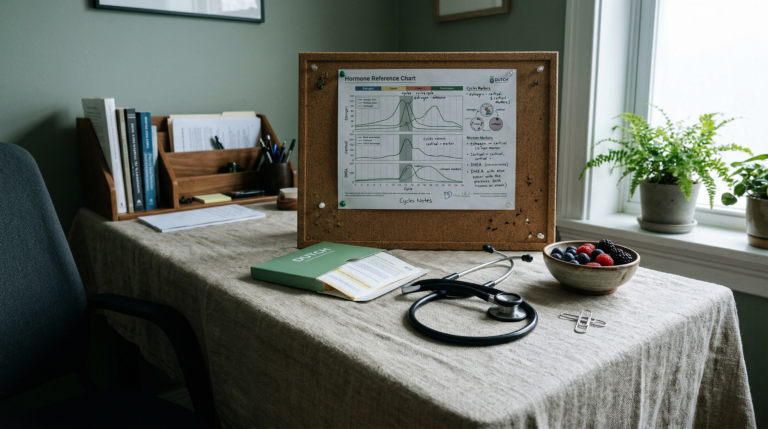
A complete workup for sleep-deprived parents starts with the Dutch Adrenal Test. This urinary panel maps the diurnal cortisol and cortisone pattern, total daily output, DHEA, melatonin metabolites, and the oxidative and methylation markers that show how the body is processing its stress hormones.[15] It catches the flattened curve, elevated evening cortisol and suppressed morning awakening response that broken sleep produces. Both partners often benefit from testing together because the patterns frequently differ and the treatment plan changes accordingly.
Bloodwork sits alongside. The functional postnatal panel for women includes ferritin, full iron studies, active B12, folate, RBC magnesium, zinc, vitamin D, omega-3 index, fasting insulin, HOMA-IR, HbA1c, TSH, fT3, fT4, TPO and thyroglobulin antibodies, oestradiol, progesterone and prolactin where cycle-relevant. For men the panel substitutes total and free testosterone, SHBG, oestradiol and DHEA-S for the female hormone markers. The clinical decisions emerge from reading the panels together rather than from any single biomarker.
The reason these tests aren’t standard is partly historical. Primary care postnatal screening was designed to catch obvious pathology, not to map recovery in physiologically depleted adults. The cost of running the full panel is offset against the cost of not running it: years of mislabelled symptoms, untargeted treatment, and recovery that never quite happens. See functional testing for the full panel and the chronic fatigue and burnout page for the broader workup template this sits inside.
What recovery looks like
Recovery in parents of young children is rarely linear and almost never fast. Realistic timelines run 18 to 24 months when both nutrient status and HPA function are addressed alongside whatever sleep improvements are possible. The earliest changes show up in energy stability, sleep quality and cognitive recovery once iron, B12 and magnesium status are repleted. Mood regulation tracks the cortisol curve as the diurnal rhythm reorganises. Hormonal markers move last because they sit downstream of the upstream drivers.
The clinical work is sequenced, not stacked. Restoring sleep where possible, repleting nutrients, supporting HPA function with appropriate inputs, and rechecking labs at three- to six-month intervals produces a clearer picture of who is recovering and where the bottlenecks remain. Treating both partners in parallel matters because a household running on two depleted physiologies recovers at the rate of the slower partner, not the faster one.
Key Insights
Frequently asked questions
How long does recovery from postnatal depletion take?
Realistic timelines run 18 to 24 months when nutrient status and HPA function are addressed alongside sleep. The earliest changes appear in energy stability and cognitive recovery once iron, B12 and magnesium are repleted. Mood and hormonal markers follow as the cortisol curve reorganises. Recovery is rarely linear, and rechecking labs at three- to six-month intervals helps track which drivers are resolving and which remain active.
Can I do these tests while breastfeeding?
Yes. Bloodwork is safe during breastfeeding and is often more clinically useful then because nutrient demand is still elevated. The Dutch Adrenal Test uses urine samples collected at home over a single day and does not interfere with feeding. Hormone interpretation accounts for the lactation state, particularly elevated prolactin and suppressed cyclical hormones. The clinical decisions change to reflect this rather than being delayed by it.
Should both partners be tested together?
Both partners often benefit from testing in parallel when sleep deprivation is the shared driver. The picture frequently differs. One partner shows HPA flattening while the other shows hyperactivation, or one carries the iron deficit while the other shows testosterone suppression. Reading the panels side by side allows the treatment plan to address the household as a system rather than as two independent cases.
Is this just postnatal depression by another name?
No. Postnatal depression is a clinical diagnosis based on mood symptoms. Postnatal depletion describes the underlying physiological state of nutrient debt, HPA dysregulation and thyroid disruption that frequently drives those mood symptoms. The two coexist often. Treating only the mood layer without addressing the upstream physiology produces partial recovery at best and ongoing relapse at worst.
Is testing worth it if my GP said my bloods are normal?
Standard GP postnatal panels look for pathology rather than for functional optimisation. A haemoglobin in the normal range can sit alongside a ferritin of 18. A TSH of 3.5 can hide an underlying autoimmune thyroid pattern visible only on antibody testing. The functional panel is designed to catch what falls between the GP’s thresholds: depletion that’s real, measurable and treatable, but not flagged because nothing is in the disease range.
Ready to find answers?
Map what’s actually been drained, in whom, and what the recovery path looks like for both partners.
References
- Walker MP. The role of sleep in cognition and emotion. Ann N Y Acad Sci. 2009;1156:168-197. doi:10.1111/j.1749-6632.2009.04416.x
- Stamatakis KA, Punjabi NM. Effects of sleep fragmentation on glucose metabolism in normal subjects. Chest. 2010;137(1):95-101. doi:10.1378/chest.09-0791
- Spiegel K, Leproult R, Van Cauter E. Impact of sleep debt on metabolic and endocrine function. Lancet. 1999;354(9188):1435-1439. doi:10.1016/S0140-6736(99)01376-8
- Irwin MR. Why sleep is important for health: a psychoneuroimmunology perspective. Annu Rev Psychol. 2015;66:143-172. doi:10.1146/annurev-psych-010213-115205
- Serrallach O. The Postnatal Depletion Cure. Goop Press; 2018. ISBN 978-1538713112.
- Bodnar LM, Cogswell ME, Scanlon KS. Low income postpartum women are at risk of iron deficiency. J Nutr. 2002;132(8):2298-2302. doi:10.1093/jn/132.8.2298
- Stagnaro-Green A. Approach to the patient with postpartum thyroiditis. J Clin Endocrinol Metab. 2012;97(2):334-342. doi:10.1210/jc.2011-2576
- Meerlo P, Sgoifo A, Suchecki D. Restricted and disrupted sleep: effects on autonomic function, neuroendocrine stress systems and stress responsivity. Sleep Med Rev. 2008;12(3):197-210. doi:10.1016/j.smrv.2007.07.007
- Holt-Lunstad J. The major health implications of social connection. Curr Dir Psychol Sci. 2021;30(3):251-259. doi:10.1177/0963721421999630
- Richter D, Krämer MD, Tang NKY, Montgomery-Downs HE, Lemola S. Long-term effects of pregnancy and childbirth on sleep satisfaction and duration of first-time and experienced mothers and fathers. Sleep. 2019;42(4):zsz015. doi:10.1093/sleep/zsz015
- Leproult R, Van Cauter E. Effect of 1 week of sleep restriction on testosterone levels in young healthy men. JAMA. 2011;305(21):2173-2174. doi:10.1001/jama.2011.710
- Paulson JF, Bazemore SD. Prenatal and postpartum depression in fathers and its association with maternal depression: a meta-analysis. JAMA. 2010;303(19):1961-1969. doi:10.1001/jama.2010.605
- McEwen BS. Stress, adaptation, and disease: allostasis and allostatic load. Ann N Y Acad Sci. 1998;840:33-44. doi:10.1111/j.1749-6632.1998.tb09546.x
- Adam EK, Quinn ME, Tavernier R, McQuillan MT, Dahlke KA, Gilbert KE. Diurnal cortisol slopes and mental and physical health outcomes: a systematic review and meta-analysis. Psychoneuroendocrinology. 2017;83:25-41. doi:10.1016/j.psyneuen.2017.05.018
- Newman M, Curran DA. Reliability of a dried urine test for comprehensive assessment of urine hormones and metabolites. BMC Chem. 2021;15:18. doi:10.1186/s13065-021-00744-3
- Hibbeln JR, Davis JM. Considerations regarding neuropsychiatric nutritional requirements for intakes of omega-3 highly unsaturated fatty acids. Prostaglandins Leukot Essent Fatty Acids. 2009;81(2-3):179-186. doi:10.1016/j.plefa.2009.05.009