Your whole week shapes your gut lining, not just what you eat
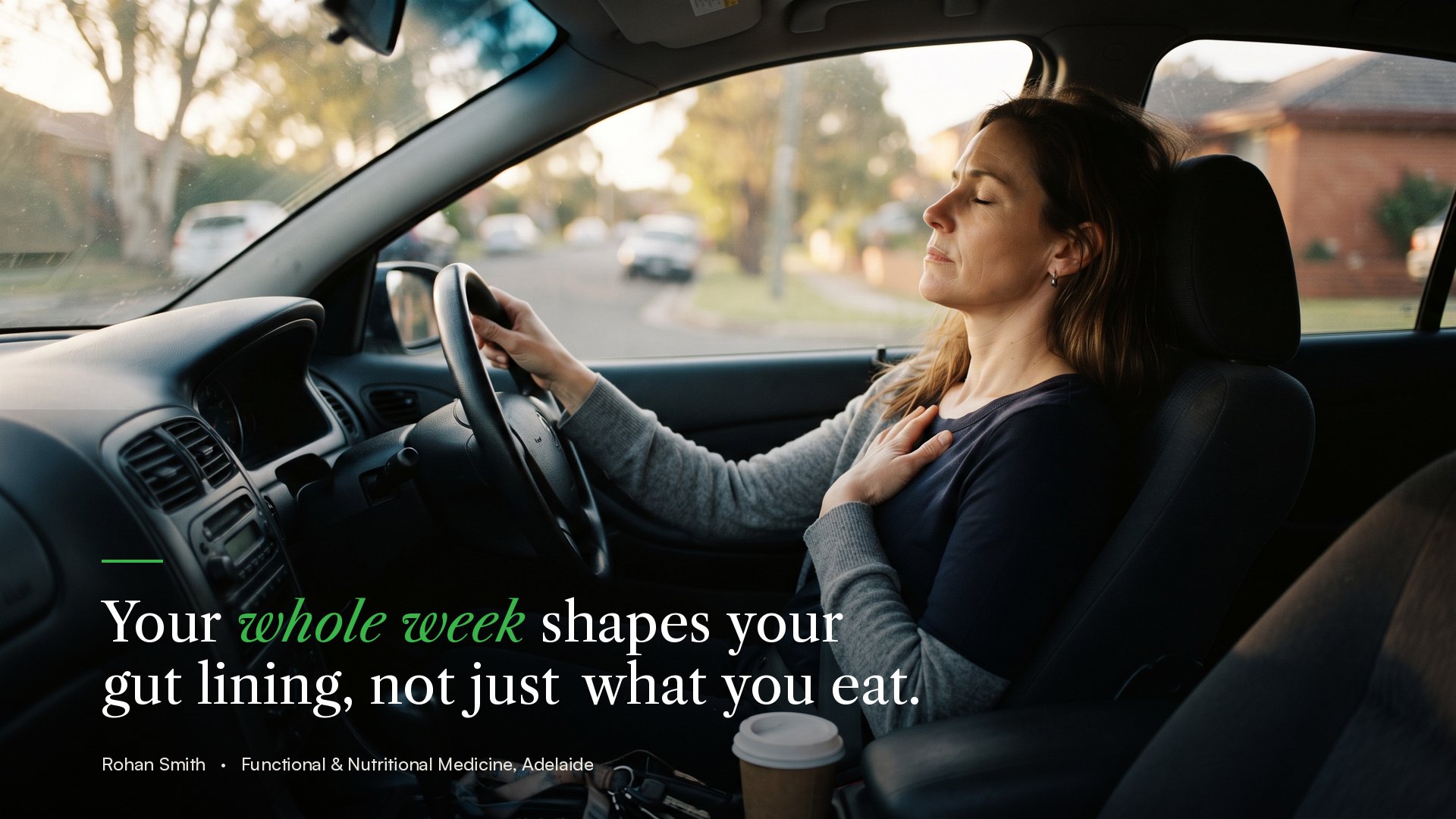
Your whole week shapes your gut lining, not just what you eat
Your gut lining is a working barrier, not a wall. It is a coat of mucus, a single layer of cells sealed together at their edges, and immune tissue underneath. Its job is to let nutrients through and keep most other things out.[1] When it loosens, more crosses into the body than should. That is what people mean by a leaky gut.
What rarely makes it into the marketing is that this barrier responds to your whole week. In one study, giving a public speech was enough to loosen the small-intestine lining in healthy volunteers, and only in the people whose stress hormones actually rose.[2] Common anti-inflammatory painkillers do the same within a day of a dose.[3] Alcohol does it.[4] A hard run in the heat does it.[5]
In a healthy gut the lining recovers. A barrier that loosens under load and then settles is doing its job. The clinical question is what stops it settling, and that is usually specific: an infection that never cleared, coeliac disease, regular painkiller use, or stress that never lets up.
What helps has better evidence than the supplement aisle suggests. In a 2025 review, feeding the bacteria you already have carried stronger evidence than swallowing new ones.[7] Sleep, movement and reducing the load that opened the barrier matter more than any single product. And no condition has been shown to resolve by repairing the barrier alone, so finding the driver comes first.[1]
What the gut lining actually does
Picture the lining of your small intestine as a single layer of cells, stitched together at their edges, with a coat of mucus on top and immune cells below.[1] Its job is selective: nutrients in, most bacteria and their by-products out.
The stitches between those cells are called tight junctions, and they are meant to loosen and tighten. That is normal physiology. A leaky gut is what happens when they stay looser than they should for longer than they should, and more material crosses into the bloodstream. It has been measured in coeliac disease, inflammatory bowel disease, alcohol-related liver disease and a subset of irritable bowel syndrome.[1][4]
The important word there is measured. It is a real finding, not a diagnosis, and it is not caused by any one thing.
A stressful day can loosen it within hours
The most striking human study on this came from Belgium. Healthy volunteers gave a public speech, and their small-intestine permeability was measured with a sugar drink and a urine test. The speech alone raised permeability, and only in the people whose cortisol actually rose, which tells you the effect ran through the stress response itself.[2]
The researchers then reproduced the effect by giving corticotropin-releasing hormone, the brain's opening signal for the stress cascade, and blocked it with a medication that stabilises mast cells. Mast cells are the histamine-releasing immune cells that sit right in the gut wall.[2] So the chain is traceable: stress hormone, mast cell, looser lining.
If your gut flares during a week of deadlines, a family crisis, or the run-up to something you are dreading, that is not imagination. It is a pathway.
Painkillers, alcohol and a hard run in the heat
Anti-inflammatory painkillers such as ibuprofen and naproxen loosen the lining so dependably that researchers use them as the positive control in permeability studies.[2] A review of the human evidence found virtually every study agrees: all conventional anti-inflammatories increase intestinal permeability within 24 hours of a dose, and the effect is just as clear with long-term use.[3] Regular use for pain, headaches or heavy periods is often the piece nobody has connected to their gut symptoms.
Alcohol has a clear effect too. In one study an aspirin challenge raised permeability in everyone tested, but the largest rise was in people with alcohol-related liver disease, whose barrier had lost its ability to bounce back.[4] The question is not only whether your barrier opens, but whether it recovers.
Exercise belongs on the list as well, and the research here is Australian. Monash researchers had endurance runners run for two hours in 35-degree heat and measured a marker of gut cell injury rising almost fivefold, with a matching rise in permeability.[6] In a companion study, taking carbohydrate during the run sharply reduced both the injury and the leak.[5] An endurance event in an Australian summer is a real load on the gut, and fuelling through it is protective.
Diet plays a part, though that evidence is younger and mostly from laboratory models. Common emulsifiers in processed food altered the structure of the mucus layer[11] and shifted the balance of gut bacteria away from species that support the barrier.[12] That is a reason to lean towards whole food. It is not a reason to fear individual ingredients.
What loosens the gut barrier, and how sure we are
Most of these are temporary. The pattern to watch for is a barrier that no longer recovers.
| Trigger | What was found | Strength of evidence |
|---|---|---|
| Acute stress | Public speaking raised small-intestine permeability in healthy adults, via cortisol and mast cells | Human study, measured directly |
| Anti-inflammatory painkillers | Every conventional anti-inflammatory raises permeability within 24 hours | Consistent across human studies |
| Alcohol | Raised permeability and reduced the barrier's ability to recover | Human study, strongest in liver disease |
| Endurance exercise in heat | Gut cell injury rose almost fivefold in runners; carbohydrate during exercise reduced it | Australian human studies |
| Food emulsifiers | Altered mucus structure and shifted bacteria | Early, laboratory models |
| Sleep loss | Weakened the proteins that hold the lining together and shifted bacteria | Animal model only |
A lining that opens under load and then settles is normal. When it stays open, there is usually a specific reason, and that reason is what a proper workup is for.
What helps it recover
A 2025 systematic review pooled 68 trials of probiotics, synbiotics and prebiotics and reported how confident we can be, not just whether markers moved. Prebiotics, the fibres that feed the bacteria you already have, lowered a circulating marker of bacterial leakage with high certainty. Probiotics lowered a different marker with moderate certainty, and their effect on the leakage marker was rated very low certainty because results varied so widely between products.[7] In plain terms, feeding your microbiome has better evidence than adding to it.
Movement helps. In adults with insulin resistance, a supervised exercise programme lowered a blood marker of bacterial leakage and improved the balance of gut bacteria.[9] In irritable bowel syndrome, moderate aerobic exercise and Pilates improved symptoms and mood, with barrier function among the proposed mechanisms.[10]
Sleep deserves a mention. In animal studies, sleep loss weakened the proteins that hold the lining together and shifted the bacteria in an inflammatory direction.[16] That has not been measured directly in people, but it fits everything else we know.
Targeted supplementation can work when it is actually targeted. In a randomised trial of people who developed diarrhoea-predominant IBS after a gut infection and had confirmed hyperpermeability, glutamine reduced symptom severity in about four out of five people compared with one in twenty on placebo, and normalised the permeability test.[8] The word doing the work there is confirmed: the trial chose people who actually had the problem.
When it doesn't settle, find the driver
The most useful sentence in this literature comes from a gastroenterologist's review: inflammatory bowel diseases do cause a leaky gut, but no such disease resolves by simply normalising the barrier, and it remains unproven that repairing the barrier improves outcomes on its own.[1]
That is a reason to ask what is holding the barrier open. Sometimes that is coeliac disease, which overlaps heavily with IBS in its symptoms and needs ruling out before anyone starts cutting out foods.[13] Sometimes it is a bug that never fully settled. Sometimes it is a medication: anti-inflammatories are the obvious one, but reflux medications profoundly change the gut bacteria too.[15] Around a third of children with food allergy have raised permeability even while symptom-free on an elimination diet, which suggests it can be a trait as much as a state.[14]
In clinic, that means a proper history before any testing: what changed when symptoms started, what you take for pain and how often, how you sleep, how much you drink, and whether there was an infection, a course of antibiotics or a stretch of sustained stress. From there, functional testing earns its place when it will change the plan, and for most people with IBS or SIBO-type symptoms the work is identifying the driver and reducing the load. Where gut symptoms sit alongside fatigue or low mood, the wider pattern matters more than any single result, and the gut-brain link deserves to be taken seriously without being oversold.
A leaky gut is a finding. The thing worth chasing is what is behind it.
Key Insights
Frequently Asked Questions
Does stress cause leaky gut?
It can loosen the gut lining, and this has been measured directly in people. Healthy volunteers who gave a public speech showed increased small-intestine permeability afterwards, but only those whose cortisol rose. The effect was reproduced with a stress hormone and blocked by a mast cell stabiliser, so the pathway is traceable. In a healthy gut the lining settles again; sustained stress is one thing that can stop it settling.
Do anti-inflammatory painkillers affect the gut lining?
Yes, reliably. A review of the human evidence found virtually all studies agree that every conventional anti-inflammatory increases intestinal permeability within 24 hours of a dose, and long-term use shows the same effect. Researchers use these drugs as the positive control in permeability studies because the effect is so dependable. Regular use for pain, headaches or period pain is often the missing piece behind gut symptoms.
Do probiotics help with leaky gut?
Modestly and inconsistently. A 2025 systematic review found probiotics lowered one permeability marker with moderate certainty, while their effect on circulating bacterial leakage was rated very low certainty because results varied so much between products. Prebiotics, the fibres that feed the bacteria already present, had the strongest result: high-certainty evidence for lowering bacterial leakage. Feeding your microbiome has better support than adding to it.
Is there a test for leaky gut?
Research studies measure permeability with a sugar drink and a urine collection, but that test is rarely used in routine clinical practice. A raised permeability result would not change the plan on its own, because the useful question is what is causing it. We focus on the history and on tests that identify a driver, such as ruling out coeliac disease, checking for infection or bacterial overgrowth, and reviewing medications and stress load.
What actually helps the gut lining recover?
Reducing the load that opened it, and giving it what it needs to settle. That means addressing stress and sleep, reviewing regular anti-inflammatory use, moderating alcohol, and eating a fibre-diverse diet that feeds your gut bacteria. Exercise helps too, provided it is not extreme endurance in the heat without fuelling. Targeted supplements can help in specific situations, such as post-infectious IBS with confirmed permeability, but that is a decision to make with a practitioner, not from a shelf.
Ready to find answers?
If your gut has been flaring with the rest of your life and nobody has looked at why, that is where we start. We work out what is holding the barrier open, then build the plan around it.
References
- Camilleri M. Leaky gut: mechanisms, measurement and clinical implications in humans. Gut. 2019;68(8):1516–1526. doi:10.1136/gutjnl-2019-318427
- Vanuytsel T, van Wanrooy S, Vanheel H, et al. Psychological stress and corticotropin-releasing hormone increase intestinal permeability in humans by a mast cell-dependent mechanism. Gut. 2014;63(8):1293–1299. doi:10.1136/gutjnl-2013-305690
- Bjarnason I, Takeuchi K. Intestinal permeability in the pathogenesis of NSAID-induced enteropathy. Journal of Gastroenterology. 2009;44(Suppl 19):23–29. doi:10.1007/s00535-008-2266-6
- Swanson GR, Garg K, Shaikh M, Keshavarzian A. Increased intestinal permeability and decreased resiliency of the intestinal barrier in alcoholic liver disease. Clinical and Translational Gastroenterology. 2024;15(4):e00689. doi:10.14309/ctg.0000000000000689
- Snipe RMJ, Khoo A, Kitic CM, Gibson PR, Costa RJS. Carbohydrate and protein intake during exertional heat stress ameliorates intestinal epithelial injury and small intestine permeability. Applied Physiology, Nutrition, and Metabolism. 2017;42(12):1283–1292. doi:10.1139/apnm-2017-0361
- Snipe RMJ, Costa RJS. Does biological sex impact intestinal epithelial injury, small intestine permeability, gastrointestinal symptoms and systemic cytokine profile in response to exertional-heat stress? Journal of Sports Sciences. 2018;36(24):2827–2835. doi:10.1080/02640414.2018.1478612
- Ghorbani Z, Shoaibinobarian N, Noormohammadi M, et al. Reinforcing gut integrity: a systematic review and meta-analysis of clinical trials assessing probiotics, synbiotics, and prebiotics on intestinal permeability markers. Pharmacological Research. 2025;216:107780. doi:10.1016/j.phrs.2025.107780
- Zhou Q, Verne ML, Fields JZ, et al. Randomised placebo-controlled trial of dietary glutamine supplements for postinfectious irritable bowel syndrome. Gut. 2019;68(6):996–1002. doi:10.1136/gutjnl-2017-315136
- Motiani KK, Collado MC, Eskelinen JJ, et al. Exercise training modulates gut microbiota profile and improves endotoxemia. Medicine and Science in Sports and Exercise. 2020;52(1):94–104. doi:10.1249/MSS.0000000000002112
- Quan Z, Song W, Huang Q, Wang J. The effects of different exercise interventions on clinical outcomes of irritable bowel syndrome and their potential mechanisms: a systematic review and network meta-analysis. Frontiers in Immunology. 2026;17:1730624. doi:10.3389/fimmu.2026.1730624
- Lock JY, Carlson TL, Wang CM, Chen A, Carrier RL. Acute exposure to commonly ingested emulsifiers alters intestinal mucus structure and transport properties. Scientific Reports. 2018;8(1):10008. doi:10.1038/s41598-018-27957-2
- Bellanco A, Requena T, Martínez-Cuesta MC. Polysorbate 80 and carboxymethylcellulose: a different impact on epithelial integrity when interacting with the microbiome. Food and Chemical Toxicology. 2025;196:115236. doi:10.1016/j.fct.2025.115236
- Makharia A, Catassi C, Makharia GK. The overlap between irritable bowel syndrome and non-celiac gluten sensitivity: a clinical dilemma. Nutrients. 2015;7(12):10417–10426. doi:10.3390/nu7125541
- Järvinen KM, Konstantinou GN, Pilapil M, et al. Intestinal permeability in children with food allergy on specific elimination diets. Pediatric Allergy and Immunology. 2013;24(6):589–595. doi:10.1111/pai.12106
- Scarpignato C, Bjarnason I. Drug-induced small bowel injury: a challenging and often forgotten clinical condition. Current Gastroenterology Reports. 2019;21(11):55. doi:10.1007/s11894-019-0726-1
- Wang Z, Zhou L, Zheng Y, et al. Nuclear receptor Nr1d1 links sleep deprivation to intestinal homeostasis via microbiota-derived taurine. Journal of Translational Medicine. 2025;23(1):1106. doi:10.1186/s12967-025-07089-8